
Two-component polyurethane adhesives often require accurate viscosity control for curing. When mixing the components, polyols engage into addition reaction with isocyanates, which increases mol. wt. resulting in higher viscosity and solidification. Multifunctional additives can be employed to assure cross-linking. However, viscosity does not necessarily increase in parallel with polymerization and such discrepancy cannot be easily explained. In this study, an oligomeric ether-ester macro diol (EEMD of 2700 g/mol) was used as a polyol, diluting it with polyethylene glycols (PEG of 200 g/mol or 400 g/mol) for viscosity control. The polyols were mixed with a trifunctional adduct of hexamethylene diisocyanate (HDI3) to initiate the addition reaction and viscosity was monitored, similarly to the previous report [1].
A rotary viscometer Lamy CP-2000 Plus was used with a 1° cone spindle RM100. Beforehand, EEMD was premixed with PEG and heated separately at 50°C for 15 minutes, as was HDI3. The polyol was mixed with HDI3 at 1+1.4 mol ratio. Within 1 min a 1 mL sample was placed onto a bottom plate of the viscometer, which was preheated to 50°C. The upper spindle was lowered and viscosity was periodically recorded at 100 s-1 shear rate. The full rotational (not oscillatory) trajectory was used and the spindle was not removed from the plate until the end of the polymerization test. Three blends were tested: w/o PEG (EEMD at 83.25%+ HDI3 at 16.75% wt/wt), with PEG 200 (at 12.1%+ EEMD at 48.5% + HDI3 at 39.4%) and with PEG 400 (at 22.3% + EEMD at 41.4% + HDI3 at 36.3%). Two runs were performed for each blend, see average values in Fig. 1.
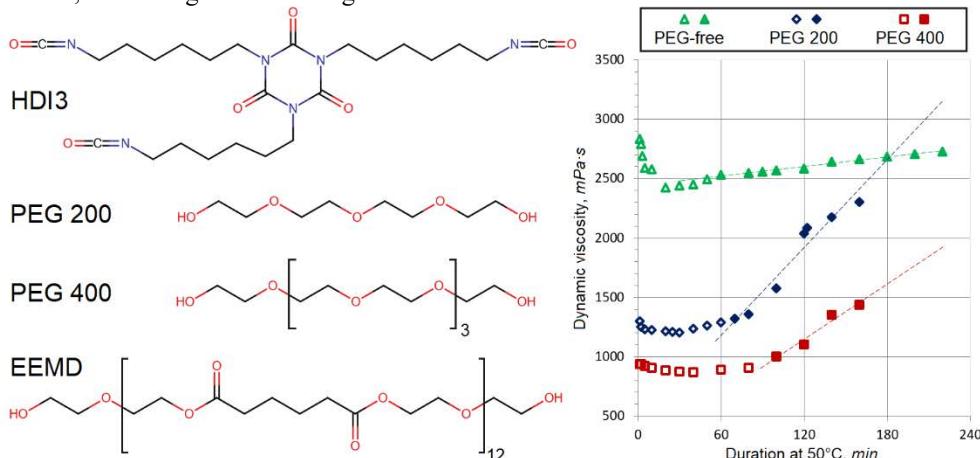
Counter-intuitively, all the blends showed some thinning initially. The drop in viscosity was the most evident in the PEG-free blend. On the other hand, this blend was more viscous than the other two. Nevertheless, its polymerization proceeded slower as a result of lower HDI3 concentration and during the later stages viscosity of PEG 200 blend became more similar. The initial viscosity drop was also evident in the blends with PEG. After the drop, viscosity stagnated or was slowly recovering for quite some time. Only well after 1 hr of polymerization viscosities finally exceeded the initial values, which were measured in the beginning of the test. Further viscosity increase approximately followed linear kinetics, with trendline correlations of the average values better than $R^2 = 0.938$.
This suggests that some induction period is present before viscosity begins increasing despite ongoing polymerization. It remains unclear, which factors might cause such induction effect. Inclusion of PEG seems to enhance the effect, because the PEG-free blend simply thinned down initially and began thickening quite soon. Bubble formation or compositional non-homogeneities in the blend are not likely to have a strong effect, since the blends were agitated quite vigorously between the cone and plate of the viscometer when measuring each point.
It might be possible that supramolecular arrangements could yield the observed induction of viscosity increase. However, more diverse formulations, extensive testing and additional analytical techniques might be needed to further elaborate on this hypothesis.