
As the field of elementary particle physics is evolving, it is becoming complicated to perform analyses with usual methods due to increasing amounts of data and rising complexity of interesting processes, thus there is the need of other analysis techniques, such as machine learning. Due to the Neural Networks' ability to recognize relationships in vast amounts of data they can be used in various analyses which contain difficult data structures. MadMiner [1] is a new tool which provides machine learning techniques to efficiently approximate arbitrary ratios of likelihood functions. MadMiner streamlines the steps involved in elementary physics data analysis. It also provides interfaces to MadGraph5_aMC [2] for the generation of events, to Pythia8 [3] for parton showering and to Delphes3 [4] for the detector simulation, therefore the tool is able to support any physics process and model.
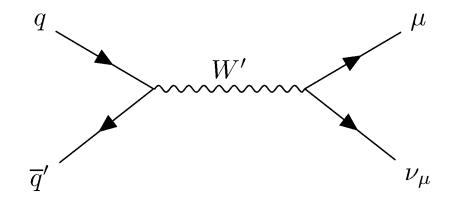
In this work we investigate the parameter space by searching for the mass of the heavy gauge boson W' [5], which is predicted in various extensions of the Standard Model (SM), including the Sequential Standard Model (SSM) [6] which we use in our work. The search is performed in the muon channel (Fig. 1) using MadMiner. To achieve that, we train neural network models on the generated data at Leading Order (LO) and use them to estimate the likelihood ratio. The ratio of Likelihood functions, in our case the ratio of SSM to the SM, is used to determine the likeliness of one model over the other. Using generated test signals we evaluate the accuracy of the pre-trained Neural Network models' ability to maximize the likelihood.