
Textiles featured with electronic function are becoming one of the major growth sectors in the multidimensional application area. Based on interactive technology, the wearable electronic textiles form a new market segment resulting from the miniaturization of electronics, and innovation for both electronic and textile industries [1, 2]. Electro-conductive textiles can be used in heating purpose particularly in medical application [3]. The aim of this work was to investigate heating behavior of fabricated knitted fabrics designed for orthopedic support. Temperature feasibility was explored based on volume of conductive yarn used in the knitting pattern. The effect of yarn linear density on the thermal behavior used in the structure was also considered and compared.
A flat double needle-bed knitting machine was used to knit Ag coated polyamide yarn with elastomeric inlay-yarn in this study. The fluke 561 HVACPro infrared thermometer and FLIR DM285 thermal imager were used to measure the surface temperature and thermal imaging of the specimens. Two copper plates of accurate dimension, electrode plates were placed on the opposite edges of the specimen and connected with DC power. The applied voltage was progressively increased and observed the corresponding values of current across the fabric were noted from ammeter. Six specimens were manufactured depending on the amount of conductive yarn used in the knitting structure and two variants of linear density of Ag coated yarn.
The surface temperature was measured at different time intervals at fixed voltage applied. The generated temperature showed that the temperature rise was found to be related to the time and applied voltage. Results confirmed that the selected electro-conductive fabric heats up quickly at first two minutes and then very slowly. Finally, this rising is leveled off at a particular temperature. Depending on the knitting structure and the amount of conductive yarn used, the thermal behavior of specimens was varied at specific voltage [4].
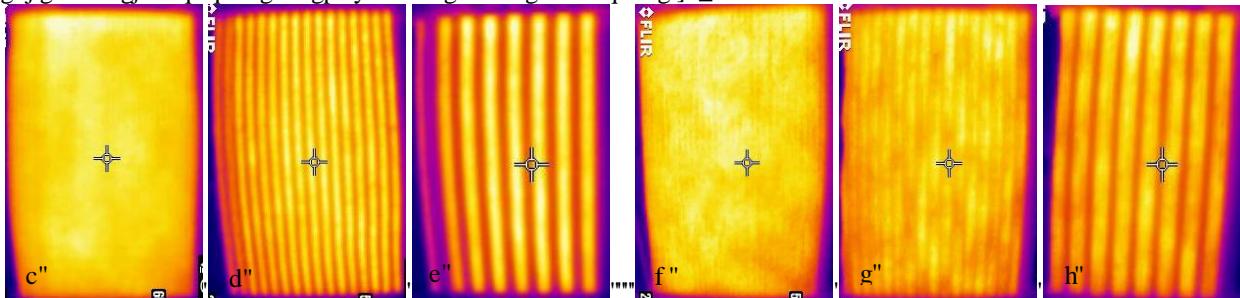
The influence of the conductive yarn distribution in the knitting pattern is clearly exhibited in Figure 1, where yellow color indicates the highest temperature (40-45°C) while the blue color, accordingly, the lowest temperature (26°C).