Amyloid plaque formation and neuroinflammatory processes are the main features of Alzheimer's disease pathology. S100A9 is pro-inflammatory, calcium-binding protein, belonging to the S100 family [1]. S100A9 protein levels are increased in many inflammatory disorders, including Alzheimer's disease [2]. In Alzheimer's disease, S100A9 serves as a junction between amyloid and neuroinflammatory cascades [3]. Due to its amyloidogenicity, together with $\beta$-amyloid S100A9 forms neurotoxic amyloid plaques [3], which results in neuronal death and memory impairment. Similar to $\beta$-amyloid, in vitro S100A9 forms cytotoxic fibrillar and annular structures [3]. However, the exact mechanism of the interaction of S100A9 with lipid membranes is still unknown.
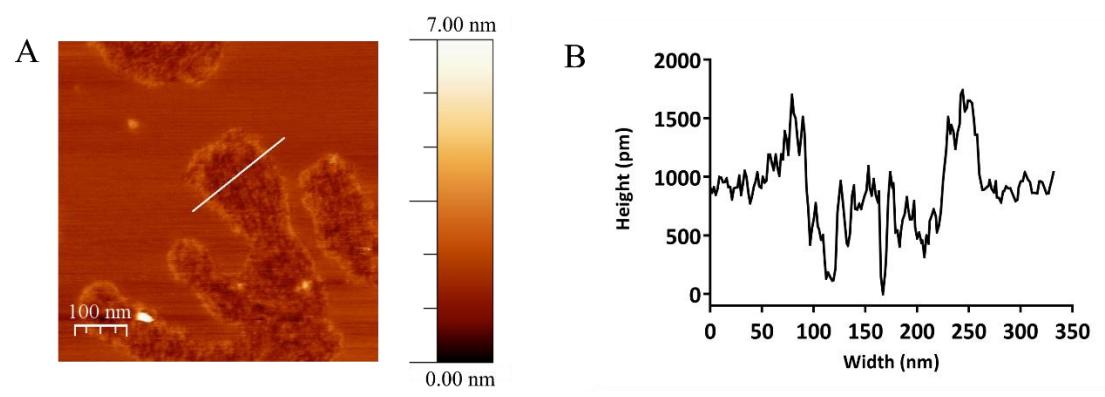
The aim of this work is to investigate the mechanisms of S100A9 protein aggregation and interaction with lipid bilayer. We used the solid supported membrane and unilamellar vesicles models to mimic the fundamental chemical and physical properties of a cell membrane. To visualize the protein-membrane interaction and to determine the nanomechanical properties of lipid bilayer, we used atomic force microscopy (AFM). AFM is non-destructive and high-resolution imaging tool. AFM not only provides information on the morphology but also on physical properties of the sample. We demonstrate that protein S100A9 induce local thinning of the membrane composed of brain total lipid extract (TLE) (Fig. 1).