To replace energy production from fossil fuel or nuclear energy, researchers have put a lot of effort into developing fuel cells (FCs) - electrochemical devices that convert chemical energy into electrical energy by oxidizing fuel at the anode and reducing oxidant at the cathode using noble metal catalysts and supplying electrical energy until sufficient fuel and oxidant are available [1]. Biological fuel cells (biofuel cells, BFCs) are devices capable of directly transform chemical energy to electrical energy via electrochemical reactions involving biochemical pathways. These devices have received considerable attention in the last few decades due to their potential use as alternative energy sources and the advantages over conventional fuel cells. BFCs use enzymes as catalysts, alone or within an organism, and tend operate under mild conditions. Therefore, they are an attractive alternative when it is not possible to use high temperatures or where harsh reaction conditions are undesirable. Enzymatic fuel cells (EBFCs) are the sub-class of FCs relying on purified redox enzymes to achieve electrocatalytic reactions [2]. EBFCs are very attractive due to high specificity of enzymes to their respective substrate, high catalytic activity at mild conditions and variety of enzymes. Moreover, enzymes immobilized on the electrode surface allow membrane-less configuration of FCs, opening up possibility of developing miniature EBFCs [3]. Researchers have focused on development of EBFCs that could supply energy using fuel oxidation, such as blood glucose, at the anode, and reduction of O2 or H2O2, which is formed during enzymatic oxidation of glucose, at the cathode [4]. Glucose and O2 are an ideal source of fuel and oxidizer because they are readily available in all organic tissues and can be constantly replenished in biological fluids during metabolism, [5]. EBFCs that use enzymatic reactions on both electrodes have also been researched and published over the past decade. It is likely that in the future, miniature membrane-less EBFCs will supply energy to implantable medical devices and will also be used as self-powered biosensors, which, using an analyte as a fuel, are able to supply themselves with energy, and at the same time determine the amount of analyte [6]. However, for this EBFCs must to produce enough energy and have a long lifetime. Therefore, the development of high-performance EBFC is still promising.
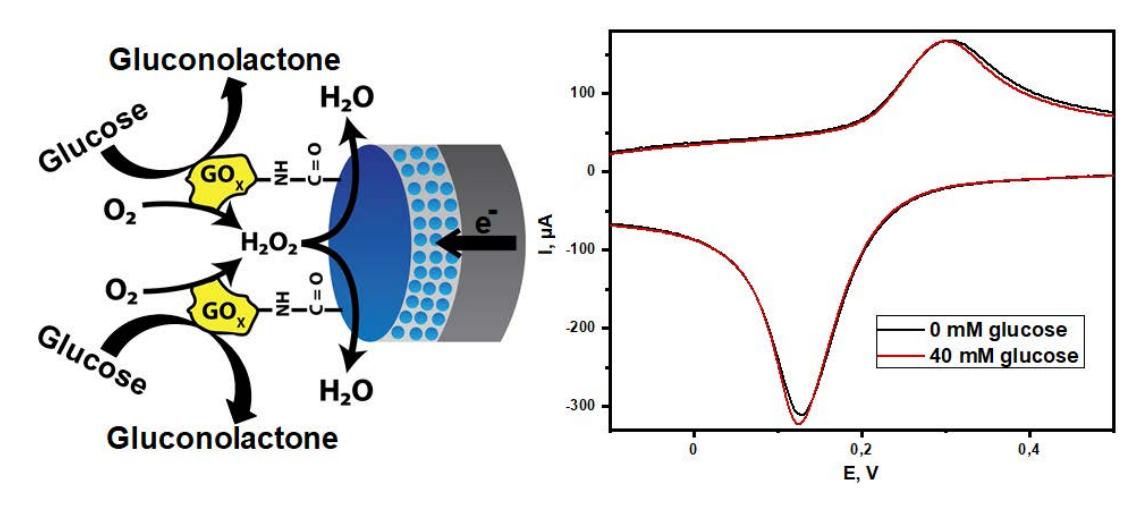
The aim of this work was to develop a biocathode for a glucose powered EBFC. The proposed biocathode was based on a graphite rod electrode with an electrochemically coated layer with electrocatalytic properties for H2O2 reduction and a layer of a conjugated polymer with carboxyl functional groups. Carboxylic groups allowed covalent immobilization of an enzyme that catalysed the reaction between glucose and dissolved O2 and produced H2O2, which was electrocatalytically reduced on the biocathode surface and caused an increase in the reduction current. The basic scheme of the biocathode and the principle of operation are shown in Fig. 1.