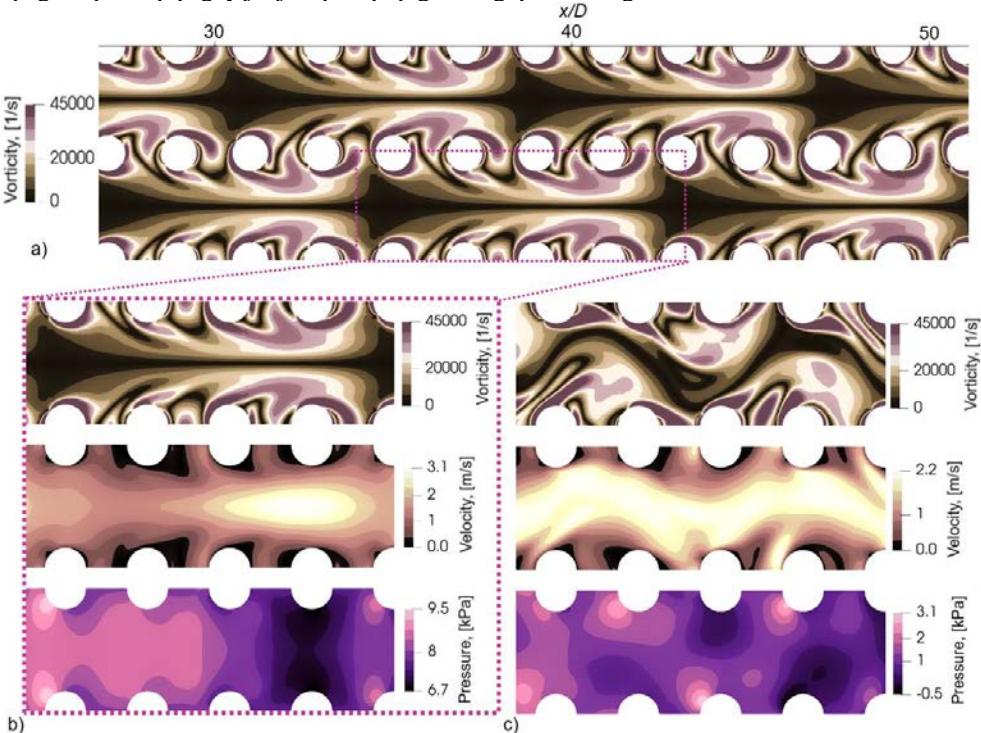
Unsteady and turbulent flow around an array of cylinders is encountered in many engineering applications, e. g., fuel and control rods in nuclear reactors, oil and gas pipelines, high-rise buildings, heat exchangers etc. Flow over two circular cylinders in a tandem, staggered, side-by-side arrangements is well investigated [1]. Nevertheless, as the number of obstacles increases, flow becomes progressively more complex. Existing research is limited to investigation of wake of the cylinder array but does not analyse the gap flow between the cylinders [2]. The coupling effect between cylinders induce wake interference, vortex synchronization, boundary layer/shear layer/wake/cylinder/vortex/gap flow interactions [3], which give rise to flow-induced vibration phenomenon causing severe challenges to the design and exploitation as a result of occurrence of loads and large amplitudes.
In this work computational fluid dynamics simulation of the flow in micro-channel is reported. Numerical 2D simulation was performed using OpenFOAM software. Validation was performed according to Renfer experiment [4], the coincidence of modelling and experimental data on average exceeds 90 %. The flow structure is dependent on gap-spacing ratio PL/T/D, where P is the cylinder centre-to-centre spacing ratio, L and T are longitudinal and transverse separation, respectively, D is the diameter of a cylinder, in this case - PL/D = 2, PT/D = 3.
Investigated configuration at certain Reynolds numbers Red experience interference of antiphase-synchronized pattern of gap flow, which is shown in Fig. 1., here $Re_{d} = u_{m}D/\nu$, where $u_{m}$ is the mean velocity of fluid between the cylinders and is $\nu$ the kinematic viscosity of fluid. Due to low PL/D ratio and higher PT/D ratio, recirculation zones lose their strength and shed alternating von Karman vortices. As the phase difference between each gap flow is $\pi$, it results in anti-phase synchronized vortex shedding, where wake zones interact with each other constructively (see Fig. 1 b)). This phenomenon leads to decreased pressure and higher kinetic energy and vorticity zones, which have abrupt gradients. Maximum speed in these zones is 40% higher than the maximum speed at the end of channel, where the in-phase vortex-shedding is observed (see Fig. 1 c)). The interference gives rise to coupled vortices and instabilities in the gap flow and wakes, which can lead to a strong increase or decrease of drag and lift forces and Strouhal number of the obstacles. In all cases vortex shedding leads to more or less fluctuating forces on the cylinders and can cause structural vibrations, resonance, acoustic noise, which can provoke failure of structure.