Gas accretion on to a supermassive black hole (SMBH) is the engine supporting active galactic nuclei (AGN). Most of the luminosity is generated by a sub-parsec scale accretion disc which forms if a significant amount of gas comes close to the SMBH, but to fully understand how activity is initiated and supported over a longer period of time, we have to study gas dynamics on various galactic spatial scales. Gas from kiloparsec scales is observed to migrate toward the centre and is seen to be accumulated in ~ 10-100 pc circumnuclear rings [1], which, as seen in recent ALMA local AGN observations, may become the reservoirs of gas feeding the SMBH [2].
One of the most important tools in studying gas dynamics are 3D hydrodynamical models. But current models have trouble accurately simulating phenomena that occur on vastly different spatial scales, e.g. ranging from the circumnuclear gas reservoir at ~ 10 pc from the SMBH to the accretion disc at <0.01 pc. Our aim is to improve simulations of the vicinity of AGN by adding a more detailed model of accretion. We do this by implementing a sub-grid accretion disc coupled to the black hole particle. We use a standard thin $\alpha$-prescription [3] that consists of a number of concentric rings and is dynamically evolved with a separate time criterion than the hydrodynamic simulation as a whole.
We test our approach by simulating a several-parsec-wide region with conditions similar to those at the centre of our Galaxy using 3D hydrodynamical code Gadget-3. The model consists of three main components: the central SMBH $(M_{\rm bh}=4\times10^6\,{\rm M_\odot})$, the Circumnuclear Ring-like toroidal gas ring $(M_{\rm r}=10^5\,{\rm M_\odot}, R_{\rm in}=1.5\,{\rm pc}, R_{\rm out}=4\,{\rm pc})$ and an infalling molecular cloud $(M_{\rm mc}=10^5\,{\rm M_\odot}, R_{\rm mc}=3\,{\rm pc})$. A retrograde collision between the molecular cloud and the gas ring results in significant accretion, where the accretion disc is fed by the gas that crosses a sink boundary $(r_{\rm sink}=0.01\,{\rm pc})$ in the hydrodynamical model.
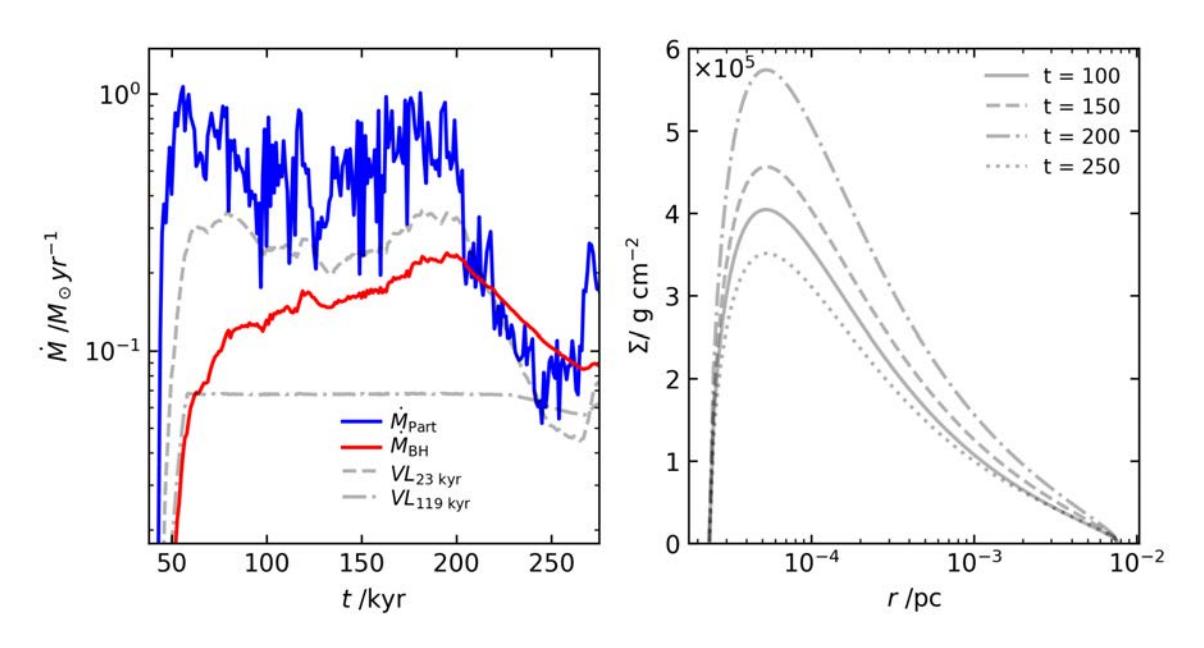
Initial results show promise. The more detailed accretion prescription does not significantly increase the computational cost. Accretion occurs more smoothly over a longer period of time as the gas moves through the viscous disc (Fig. 1, left). Various parameters of the accretion disc can be followed over time (e.g. the surface density in Fig. 1, right), which allows us to add a more precise prescription for feedback and mass loss due to luminosity exceeding the Eddington rate, which we plan to do in the future.