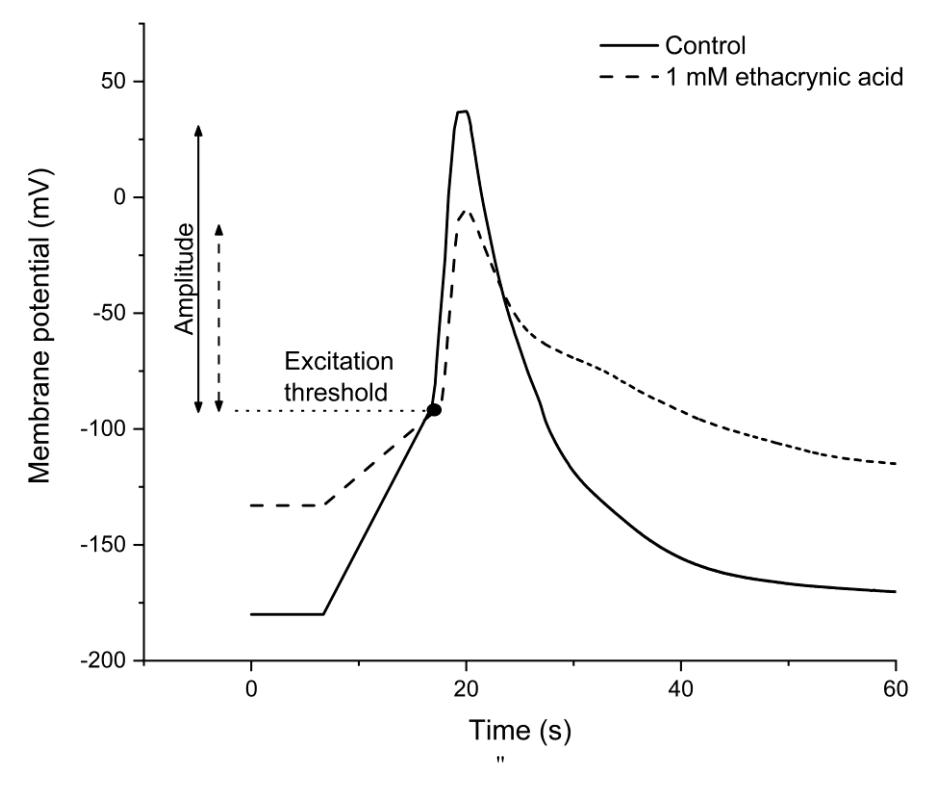
In plant cells, action potentials (AP) begin with an increase of cytoplasmic Ca2+ concentration, consequently the Cl- efflux via specific ion channels is activated – this causes the depolarization of cell membrane. It is difficult to distinguish Ca2+ influx from Cl- efflux because they carry unidirectional current. To date the characteristics and standardized assessment of influx of Ca2+ have not been described. Thus, we used ethacrynic acid (EA) to block Cl- channels in giant Characeaen cells. The effect of 1 mM EA solution on Nitellopsis obtusa electrophysiological parameters were tested using intracellular glass microelectrode and two pair current/voltage clamp methods.
For the first time, in addition to the decrease of Cl- efflux current upon exposure to EA, the alterations of AP parameters were described. AP peak from the usual positive values was reduced to negative ones, thus AP amplitude was also decreased by 30%, while the excitation threshold was not altered at all. Furthermore, depolarization of the membrane resting potential with increased specific resistance and a surprisingly extended duration of repolarization phase was observed upon exposure to EA – thus implicating interference with other ion transport systems.
Summarizing current/voltage clamp results we affirm that in plant cells AP amplitude is dependent on Cl- efflux. We conclude that the action potential excitation threshold does not depend on chloride channels' activity.