
Nowadays, the higher human's longevity provides new challenges how to maintain hearing loss, due to the ageing. Despite that, the hearing loss may result from genetic causes, complications at birth, certain infectious diseases, chronic ear infections, the use of drugs and even the exposure to excessive noise.
One cause of hearing loss is the none-transmission of the sound vibration in the middle ear due to the failure in the ossicular chain. In this case, an ossiculoplasty can be done, and the prosthesis will be placed to recreate the initial mechanism of the hearing, by reconstructing ossicular chain. In the case of conductive hearing loss, the conventional hearing aid does not work and the usage of hearing aid, which is composed from the implant and prothesis, becomes inevitable.
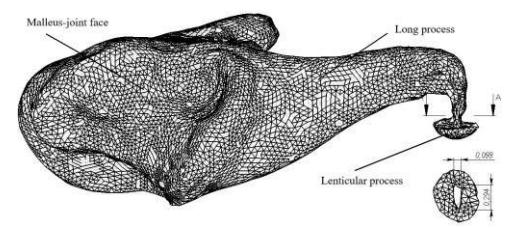
Concerning the reconstruction of ossicular chain, the selection of the type of protheses depends on the clinical situation and of the amount of damage. For example, Yuang [1] summarized ossicular damage in the patients with atelectasis and found that for 72% of cases in posterior retraction pocket only incus was eroded. As it was found in previous research [2] 'working', but injured incus (Fig. 1) must be replaced and appropriate prothesis must be selected. Finally, for the reconstruction of the ossicular chain, a large variety of protheses (different materials and shapes) have been proposed. So, here the CAD/CAE systems are applied to differentiate the behavior of prothesis, according to the shape and used material.
Bone anchored hearing aids (BAHA) are surgically implanted by drilling a special fixation hole in slow speed in order not to overheat the bone, what finally could impact the conduction of sound from the processor. Detailed BAHA implant is presented in Fig.2., which was modelled to study implant's fixation.
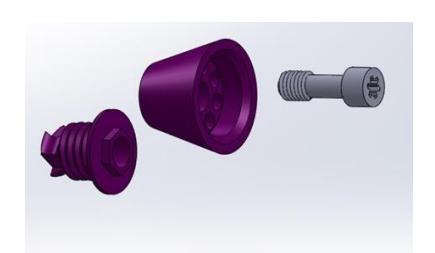
SolidWorks software was used for the conception of the numerical 3D models and CAE analysis.