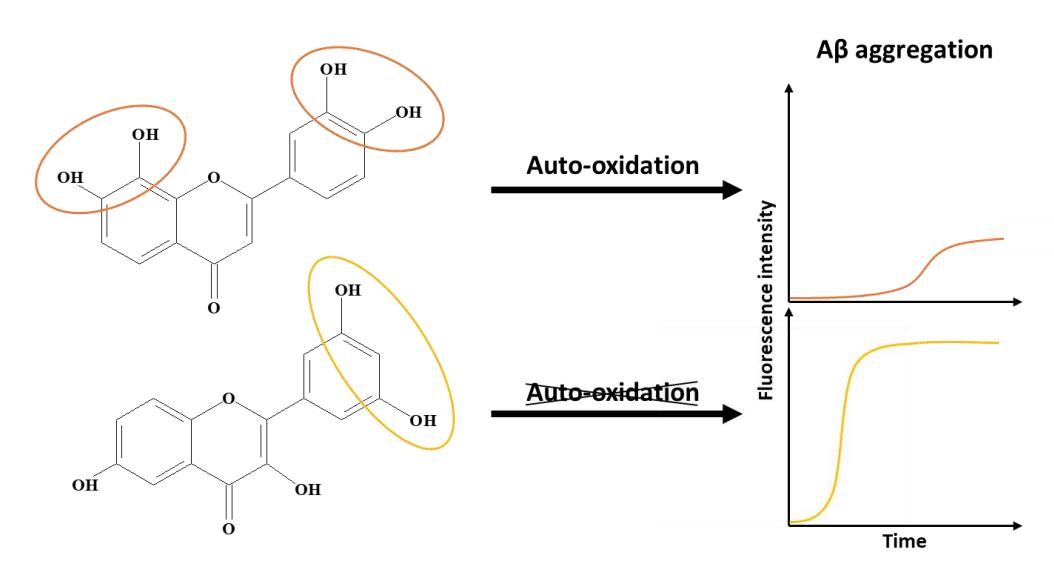
Protein accumulation into highly dense structure aggregates is associated with multiple neurodegenerative disorders [1]. Alzheimer's disease (AD) was recognized to be the most prevalent condition that affects over 35 million people worldwide and is projected to increase up to 76 million by 2030 [2]. Typically, Alzheimer's disease onset at the age of 60 or later, with leading symptoms of progressive decline in memory and other distinct cognitive capabilities [3]. The pathology of this disease is linked to the aggregation of amyloid-beta ($A\beta$) and the formation of Tau neurofibrillary tangles. $A\beta$ aggregates are found at the very early stage of the disease, thus the inhibition of this peptide formation and aggregation has profound attention of scientists [4]. Over the years, various compounds were suggested for treatment, however, the effort to find disease-modifying drugs were not rewarding leaving more than 99.5% of clinical trial unsuccessful [5]. Yet, in this research, we focus on the flavones as the potential inhibitors of $A\beta$ aggregation. Flavones are natural antioxidants and exhibit neuroprotective and anti-inflammatory effects. The flavones belong to the group of acetylcholinesterase inhibitors, which is shown to have the best positive effect on the treatment of AD symptoms [6]. Although many protein aggregation experiments in vitro using flavone derivates show positive results, the in vivo results are not flattering. This may be related to a different oxidation mechanism at physiological conditions in vivo and in vitro leading to environmentally distinct oxidation products [7], [8].
In this study, we show the link between flavone hydroxy-groups position and the oxidation derivatives that possess $A\beta$ and insulin amyloid aggregation inhibition effect (Fig. 1). The insulin amyloid aggregation was added to this research to analyze flavone inhibition potential at the conditions where auto-oxidation does not occur, thus both non-oxidized and oxidized flavone particles were tested. The absorbance spectrum data reveal that not all tested flavones undergo auto-oxidation at the experimental conditions. The $A\beta$ and insulin aggregation kinetic data show the extreme change of aggregation halftime after compound auto-oxidation. In addition, the atomic force microscopy images display the morphology of the fibrils formed during the experiment.