
Copper(II) isopoly tungstates (CuIPTA) have a variety of perspective properties that allows to use them as antiviral and antitumor medicines. Considering this, the search of new synthesis routes, the structure and properties characterization of this compounds are actual research tasks.
The most studied among CuIPTA are paratungstates which contain the [W12O40(OH)2]10– anion. These compounds are usually synthesized by an exchange reaction from dissolved in water alkali metal paratungstate, or from acidified to the needed acidity (Z = C(H+) / C(WO42-)) aqueous solutions of orthotungstate anion during self-assembly. The second synthesis route is simpler and faster, because it does not require the synthesis of alkali metal paratungstate B.
At the same time the acidity range where definite isopoly anions dominate are rather wide. And the synthesis can be done in a wide pH range of solution. Thus, an aqueous solution of Cu2+ – WO42- (Z = 1.17) – H+/OH- – H2O was studies by methods of mathematical modeling, which made it possible to determine the most accurate Copper(II) paratungstates B synthesis conditions.
In this regard a pH-potentiometric titration of the Cu2+ – WO42- (Z = 1.17) – H2O system by acid or alkali in Z = 1.17–1.67 and Z = 1.17–1.05 acidity ranges respectively with the $μ$ = 0.05; 0.10; 0.15; 0.20; 0.25 (mol·L-1) ionic strengthes was carried out. The titration results were used for modeling in CLINP 2.1 program which showed that the expected Anderson heteropoly anions were not formed at this acidity range. A model with [Cu2+, W12O40(OH)2]8-, [Cu2+, HW12O40(OH)2]7-, [Cu2+, H2W12O40(OH)2]6-, [Cu2+, H3W12O40(OH)2]5– ion pairs and CF=50.19 ($x^{2}_{exp.}$ = 28.70 << $χ^{2}_{f, α=0.05}$ = 54.57) was chosen to describe the ion state in the system. That explains the preservation of the homogeneity of the system at a sufficiently high content of free Cu2+ and WO42- ions.
Interactions in the system were investigated by conductivity measurement which can prove the presence of ion pairs between Copper(II) cations and isopoly tungstates anions of the 12th row.
The calculated values of the logarithms of concentration constants of the anions formation at the corresponding values of ionic strength were used to calculate the logarithms of thermodynamic constants lgK° by the Pitzer method by extrapolating the dependence lgKc = f($μ$) to $μ$ = 0 (mol·L-1).
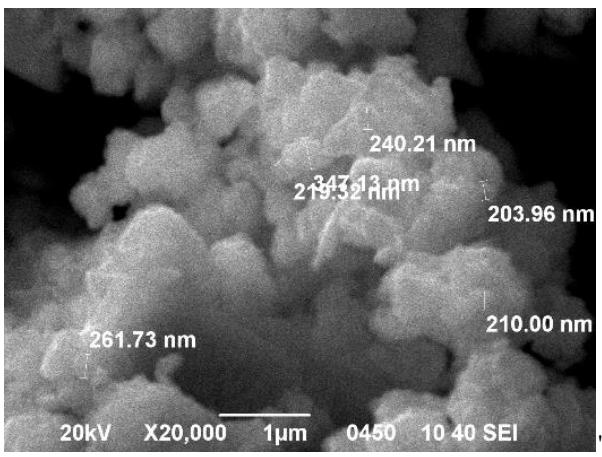
A new synthesis procedure was developed and a new sodium-copper(II) paratungstate B Na2Cu3(CuOH)2[W12O40(OH)2]·32H2O in acidified to Z = 1.17 aqueous solution with C(Na2WO4) = C(HNO3) = 0.05 (mol·L-1) and C(Cu(NO3)2) = 8.3333·10-3 (mol·L-1) was synthesized. The obtained salt was studied by chemical elemental analysis, scanning electron microscopy (SEM) and FT-IR spectroscopy. The study of surface micromorphology showed that salt exists in the form of plates with 240-340 nm grain sizes (Fig. 1). The proposed synthesis procedure can be used to obtain similar salts with cations of other d-metals.
The study was carried out within the Fundamental Research Programme funded by the Ministry of Education and Science of Ukraine (grant ID 0119U100025).