
Bacteria can be found everywhere: in hospitals, industrial places, food facilities and even spacecraft. The emergence of antibiotic-resistance amongst bacteria is one of the most pressing worldwide issues. One of the promising approaches to treating such bacteria is antimicrobial photoinactivation (API). API is an efficient biophotonic technology based on the interaction of photosensitizer (PS), molecular oxygen, and low doses of light of suitable wavelength to match the PS absorption peak [1]. The interaction of PS and light, in the presence of oxygen results in a plethora of cytotoxic reactions and consequently, induces selective destruction of the target bacteria. Antibacterial efficiency of the API depends on many factors, but most significant on the photophysical properties of used PS. This study focuses on natural PSs - riboflavin (RF) and chlorophyllin (Chl). They are known as human non-toxic and safe for environment photoactive compounds used as food colourants E-101 and E-140ii, respectively [2]. RF (water-soluble Vit B2) is a compound that is quickly degrades by light. According to literature, RF absorption maximums are at 223, 267, 373 and 444 nm. The light-induced RF activation can show potent cytotoxicity and selectively damage different bacteria. Chl is known as a water-soluble, green, negatively charged compound with the main absorption maximum at 405 nm. Therefore, a LED-based light source of light wavelength 405 nm was used in experiments for the optimal excitation of Chl. It is a semi-synthetic porphyrin obtained from chlorophyll that generates reactive oxygen species with antimicrobial activity after exposure to visible light.
Both PSs are known to change the optical absorbance after activation by light. These changes show the activation dependence on excitation dose and can be used to compare the irradiation efficiency by different spectral components. Therefore, the absorption spectra of RF and Chl were investigated after illumination with 450 nm, 405 nm, 4000 K light (Fig.1).
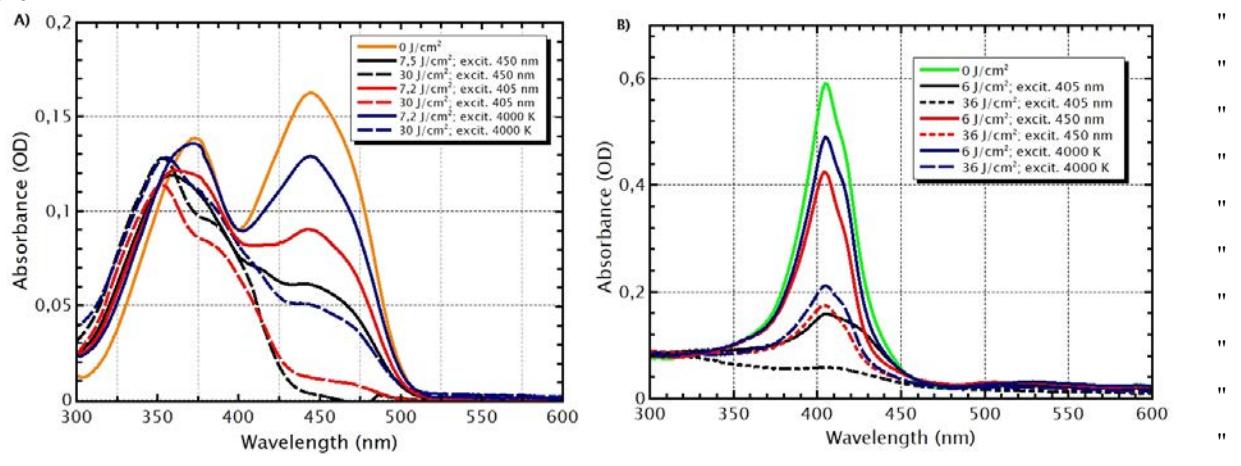
The photodegradation effect depicted in Fig. 1A shows that RF can be excited by 450 nm as optimal and by 405 nm and 4000 K light with relative efficiencies of 0,3 and 0,23, respectively. The photodegradation experiments helped assess the RF stability level and revealed it's photodegradation products after specific illumination exposures. It is known that the aqueous solutions of Chl are also sensitive to light. Our experiments showed that all three irradiance sources (405 nm, 450 nm and white 4000 K) excite Chl, but photoactivation efficiency is different. The photodegradation effect depicted in Fig. 1B shows that Chl can be excited by 405 nm as optimal and by 450 nm and 4000 K light with relative efficiencies of 0,42 and 0,15, respectively. Also, storage stability and photostability of both PSs in the mixture and separate solutions were analyzed. To conclude, RF and Chl are promising natural PSs that can be widely applicable, but the further investigation must be performed.