
Two-photon lithography (TPL) technique has shown the versatility of creation of true three-dimensional (3D) microstructures for optical applications in the recent years. Most of the 3D geometries are a combination of basic shapes such as plane surfaces, curved surfaces, and sharped edges. For this reason, we focused this work in the design of spherical lenses and rectangular prisms which fulfill such conditions. Different approaches have been done for the fabrication of curved surfaces resulting in different surface quality. Writing by subregional slicing [1] and equal-arc slicing [2] methods have shown an improvement in the optical quality of the structures, but the complexity of the implementation limits the fabrication process. The TPL is based on point-by-point process allowing overlapping of voxel during fabrication which determines the lens quality and surface smoothness. We implemented a spiral sphere writing method based in the parametrization in Cartesian representation of the two-dimensional Archimedean spiral in polar coordinates for the writing of concentric shells to form lenses [3].
To optimize the imagining performance of micro-optical elements, detailed knowledge of dispersion is required. Different methods for refractive index characterization have been used, such as interferometry [4], ellipsometry [5], coupler prism m-lines [6], and critical angle by total internal reflection [7]. However, these techniques can be applied only with two-dimensional specimens. We propose a refractive index measurement technique based on the index-matching oils method [8]. The versatility of the proposed method could lead to accurate measurements of refractive index of complex three-dimensional structures and not only two-dimensional flat structures. To perform such measurements, we designed an array of spherical lenses and rectangular prisms with same geometrical characteristics based in the proposed writing method.
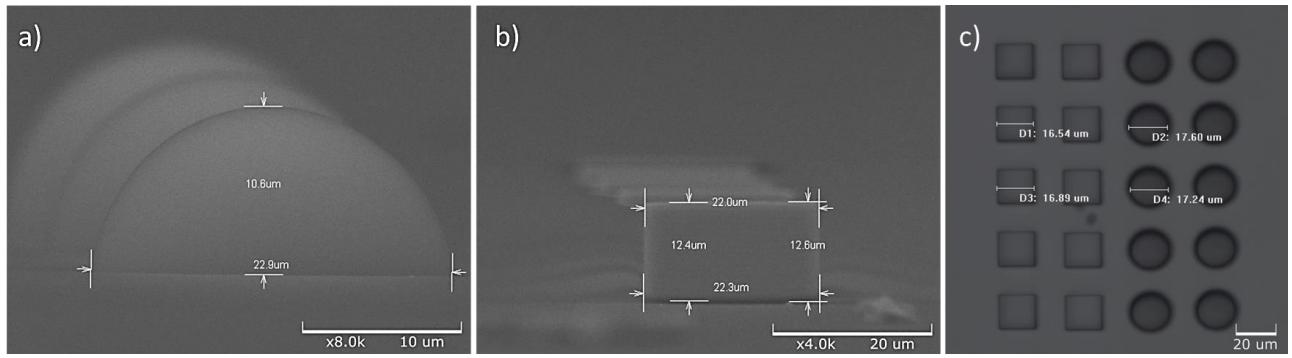
We successfully fabricated arrays of elements by TPL system using a 515 nm beam with 80 fs pulse duration 76 MHz repetition rate. Mixture of SZ2080 with 1 weight percent of photoinitiatior was used as prepolymer solution. Using the proposed spiral sphere writing method, we fabricated spherical lenses and linear scanning writing method for layer-by-layer fabrication of rectangular prisms. We achieved high repeatability of structures and error in dimensions below the required for the application of interest.