
Supercontinuum (SC) generation is an effect produced by filamentation of ultrashort laser pulses in transparent dielectric media and resulting in broad spectra with high spatial and temporal coherence [1]. SC generation in the ultraviolet (UV) spectral range is highly demanded in ultrafast time-resolved spectroscopy. However, UV SC generation is still a complicated task due to the scarcity of suitable nonlinear materials. Spectral broadening in alkali metal fluorides (BaF2, CaF2, MgF2, LiF, LiSAF) produces spectra with the largest blue shifts. As a rule, CaF2 crystal is widely considered to be the preferred material for UV SC generation due to its properties: large bandgap of 10 eV, wide transparency in the UV (short-wavelength absorption edge at 120 nm) and low chromatic dispersion [2]. However, under standard (tight focusing, thin crystal) experimental conditions for SC generation CaF2 (and other fluorides) undergoes rapid color center formation as well as heat accumulation even at relatively low (1 kHz) pulse repetition rate. This eventually leads to optical damage and results in SC spectrum narrowing within seconds. To produce stable SC generation for longer periods of time, CaF2 crystal has to be continuously translated or rotated with respect to the pump beam [3]. This complicates experimental setup and calls for optimisation of experimental settings for SC generation in the UV by proper choice of pump wavelength and focusing geometry.
In this study, we investigate SC generation in an untranslated thick (25 mm) CaF2 crystal using loosely (NA = 0.0044) focused 515 nm pulses provided by the second harmonic of Yb:KGW laser having a pulse duration of 180 fs and a central wavelength of 1035 nm at a repetition rate of 10 kHz. SC generation in thin (5 mm) CaF2 crystal in tight (NA = 0.0117) focusing conditions was measured for a comparison.
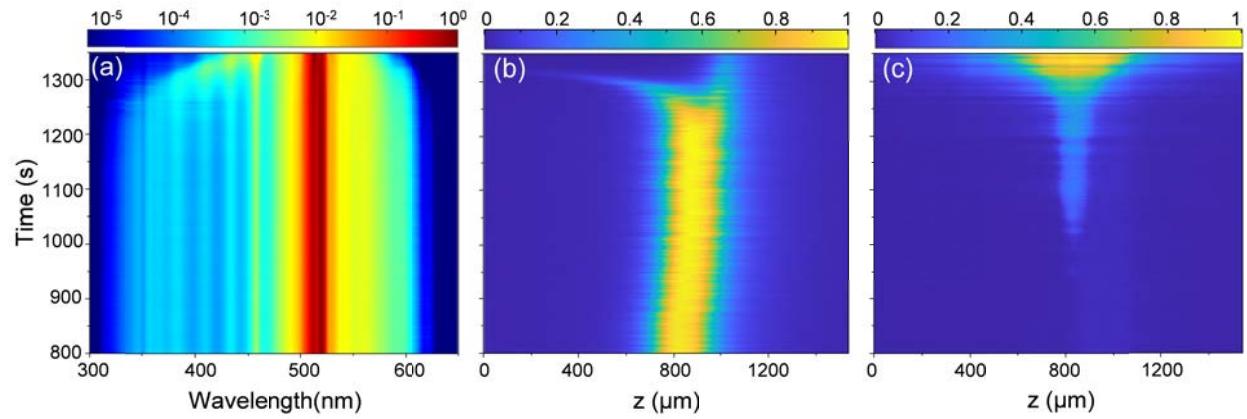
We demonstrate that the blue-shifts (at ~300 nm) of SC spectra do not depend on focusing condition. However, almost no red-shifted spectral broadening was observed using tight focusing conditions, while symmetric spectral broadening (up to 635 nm) was observed with loosely focused pump beam. This observation is explained by enhanced self-steepening of the leading pulse front [4]. Experiments show that SC spectrum shrinks rapidly (in a few seconds) under tight focusing conditions in a thin CaF2 sample, whereas damage-free SC generation for 20 min was observed in an untranslated thick crystal using loose focusing conditions (Fig. 1 (a)). We also recorded the dynamics of the filament-induced luminescence trace and light scattering (Figs. 1(b) and 1(c)), which demonstrate a correlation between shrinking of SC spectrum, filament break up and occurrence of strong scattering due to evolving optical damage. The longevity of SC spectrum is explained as a result of dynamic balance between the rate of color centers formation and decay.