Reversible hydration of carbon dioxide to bicarbonate is catalysed by a family of carbonic anhydrase (CA) enzymes. In mammals, they often exist in multiple isoforms and participate in various physiological processes, including CO2 and HCO3- transport in blood, regulation of pH and electrolyte homeostasis, and some metabolic pathways. Because of their high involvement in physiological processes, human carbonic anhydrases are associated with several diseases, e.g., CA I is linked to haemolytic anaemia, and CA II – to glaucoma, among others [1]. Their inhibitors are used to control some of these diseases. For medical research purposes, CAs are challenging targets due to high homology and structural similarity between isoforms. The CA isozymes have different levels of kinetic activity, sulphonamide inhibition [2], and are expressed in different tissues. Of particular importance are cytosolic CAs because they are the most abundant class of isoforms. To expand comprehensive views on mammalian CA, research on mice CA (Car) and ligand interactions is performed. Information about Car and small molecule ligand binding could contribute to filed of the drug development for specific CAs.
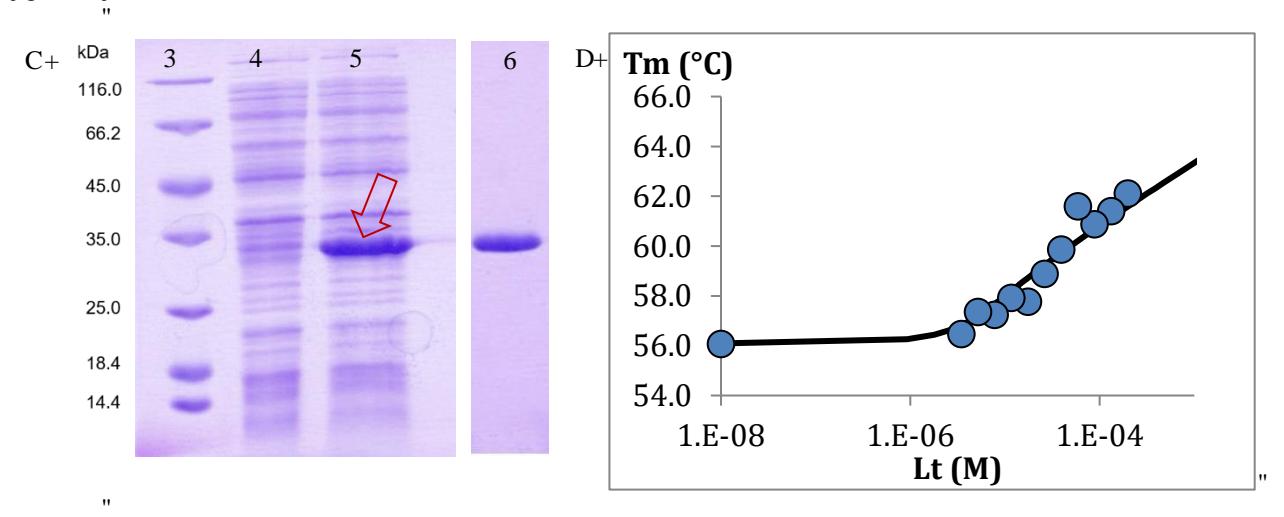
Here we will present cytosolic Car cloning strategy, expression, purification, and small molecule binding examined by the fluorescent thermal shift assay. The cloning of all Car proteins started with amplification of DNA sequence by PCR, creation of sticky ends with restriction by endonucleases, ligation into pET-15b plasmid, and transformation of Escherichia coli bacteria. Growing conditions for a sufficient amount of recombinant Car were optimized by shuffling the E. coli strain and varying the protein expression conditions, e.g., amount of added ITPG or using different kinds of zinc salts. The proteins were purified using immobilized nickel ion affinity chromatography. The fluorescent thermal shift assay was used to assess the protein thermal stabilization [3] by binding small molecule ligands. Figure 1A presents optimized results of Car XIII expression and purification, while 1B shows its binding to dichlorophenamide by fluorescent thermal shift assay.