Recently, noble metal nanoparticles (NPs) have been very interesting for the scientific community because of their electroptical properties that appear because of localized surface plasmon resonance (LSPR) [1]. Due to their LSPR features plasmonic metal NPs can be used in various electrooptical applications like solar cells, photocatalysis, sensing, medicine and so on [1].
We investigated Ag, Au and Cu NPs in our research because these nanoparticles have well defined LSPR properties and shows great promises for future electrooptical applications [1]. Most metal NPs were synthesized chemically so far but with the development of ultra-short pulse lasers, new methods of synthesis of NPs have emerged like laser ablation in liquids (LAL). The important advantage of LAL is a simple and fast synthesis process. To evaluate the sizes, structural and optical properties of NPs prepared by the LAL method their properties should be explored in detail. The methods like scanning electron microscopy, X-ray diffraction, linear and nonlinear optical measurements can give valuable information about features of these NPs. In our research, we were focusing on the ultrafast LSPR relaxation dynamics of NPs synthesized from three plasmonic metal targets by the LAL technique.
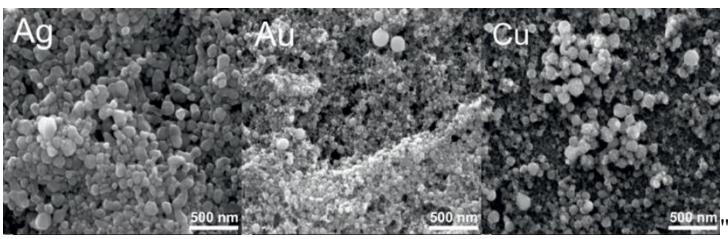
The dynamic plasmonic properties of noble metal nanoparticles were explored by ultrafast transient absorption spectroscopy (TAS) method exploiting Yb:KGW femtosecond laser and nonlinear parametric amplifier. The properties of ultrafast LSPR relaxation dynamics in plasmonic NPs prepared by the LAL method were compared with the ones prepared by chemical synthesis [2]. The TAS measurements results of Ag, Au and Cu NPs are shown in Fig. 1. The sizes and shapes of investigated plasmonic metal NPs were measured with SEM and calculated with ImageJ software (Fig. 2).
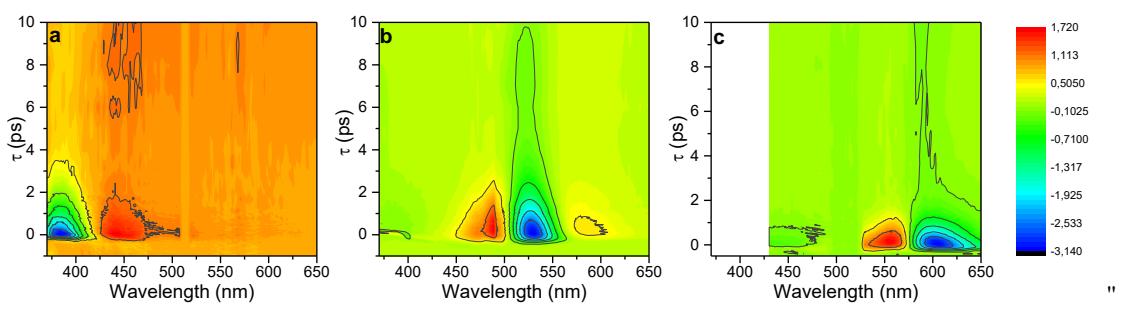
he TAS results display that the dynamic properties LSPR of LAL NPs are quite similar to NPs prepared by the wet chemical synthesis method suggesting that their quality is also comparable [2]. Although, the relaxation dynamics of NPs prepared by wet chemistry and LAL is quite similar the sizes distribution is much lower for NPs prepared by wet chemistry methods (Fig. 2) [2]. The preliminary results indicate that the LAL synthesis of NPs could be a perspective method for the preparation of high-quality plasmonic NPs for various electrooptical applications.