
A straight way into generating ultra-short optical pulses - is a supercontinuum generation followed by broad-banded pulse temporal compression. There are variety of ways for pulse spectrum broadening techniques, however, recently a lot of attention was dedicated to, so called, multi-plate continuum generator setup. The idea behind it is simply divide a bulk medium into thinner fractions (order of parts of millimeter) and place them at certain distances along the focused pulse propagation direction [1]. It allows to get significantly higher pulses energies at the continuum generator output, compared to traditional methods (even more than a thousand times!). Moreover, the supercontinuum pulses from multiplate setups can be compressed to virtually transformation limited pulse [2].
Dividing bulk medium into thinner plates allows to bypass unwanted nonlinear optical effects that distorts pulse spatio-temporal properties (for example, multiple filamentation). This is avoided because required intensity for such effects inside a bulk medium is reached outside plates, where intensity requirements for same phenomena are way higher.
Several nonlinear optical effects contribute to pulse broadening. However, only two (or maybe even one, depends on generator setup) has considerably larger contributions: self-phase modulation and pulse splitting. While self-phase modulation slowly but consistently broadens pulse spectrum, pulse splitting does it instantaneously and indicates itself with asymmetrical broadening of the spectra and pedestal in shorter wavelength region.
As mentioned, before it depends on multi-plate generator setup whenever pulse splitting will occur or not. If all broadening is done at once - pulse splitting will occur. However, if firstly pulse passed number of plates before it splits and then it gets compressed it can be guided through the rest of the plates, and pulse splitting (and pedestal in spectra) will not occur. This leads to even better pulse compression in time. To get a detailed information about pulse chirp after it was broadened its convenient to use frequency resolved optical gating (FROG) method. Moreover, at the same time we will also get pulse length.
In our experiment multi-plate setup was pumped with Ti:sapphire laser with a central wavelength being approximately 800 nm. Laser pulse was investigated with FROG and it was figured out that pulse length is ~50 fs. We used pulse energy as high as 0.5 mJ. Plates had different thickness: five - 0.1 mm and two - 0.2 mm. The broadened spectrum was approximately from 500 to 1000 nm. The result after all plates was the same whenever first plates were thinner or thicker, however, spectra after same number of plates (1, 2, ... etc.) were slightly different.
For any kind of application, the stability of output pulse characteristics is of high importance. The energy measurements during one hour of continuous operation has shown high stability of output radiation with standard deviation of 0.02. The results are presented in Fig. 1.
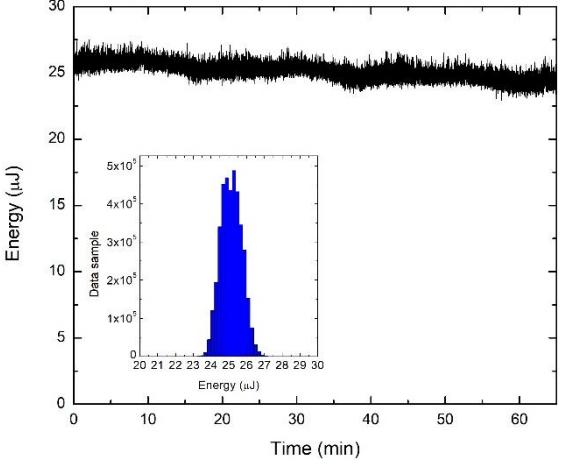
After measuring the input energy and output energy we got that our used setup transmittance is ~83%. The energy in the central part of supercontinuum radiation is ~50% of an input energy.
Presentation will include more data on energy, spectral and temporal characteristics, and prospects for compression of pulses from multi-plate setup.