
Overuse of fossil fuels has resulted in serious environmental problems, and global energy shortages have become an increasingly urgent issue. Consequently, clean and renewable energy sources such as solar energy have become an attractive way to address this energy crisis. Photoelectrochemical (PEC) water splitting and organic pollutant degradation driven by visible light have attracted worldwide attention as promising applications of solar energy. However, a key technical problem faced in PEC application is the development of suitable photoelectrodes, which play an important role in the PEC conversion of solar energy to chemical energy[1].
Over the last two decades, bismuth vanadate (BiVO4) has attracted much attention as one of the most efficient, robust and inexpensive metal oxide photoanodes. Photoactive c-BiVO4 with 2.4 eV band gap energy can absorb UV and visible light up to 520 nm [2]. Particle size, porosity and morphology of bismuth vanadate can be controlled with the help of structure directing agents used in the synthesis.
In this work sol-gel approach and dip-coating technique was applied to synthesize bismuth vanadate coatings using different amounts of polyethylene glycol (PEG) (1% and 3%) as a structure directing agent. It was investigated how different BiVO4:PEG ratios influence the morphology and photoelectrochemical response of the thin films. Composition and morphology of the coatings were analyzed by means of XRD and SEM techniques. TG-DSC analysis was used to analyse the thermal decomposition of the precursor solution mixture. Photoelectrochemical activity of BiVO4 films was investigated using cyclic voltammetry in three electrode cell in 0.5 M NaCl solution in the dark and under illumination.
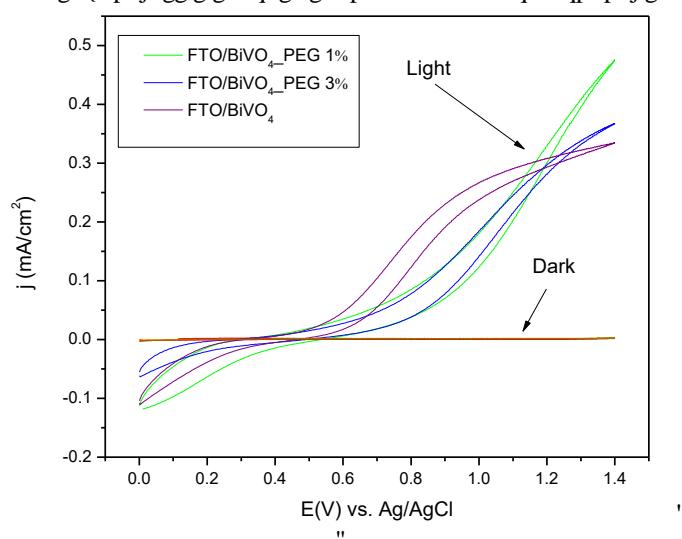
It was found that morphology of coatings strongly depends on amount of PEG used in the synthesis. Results of cyclic voltammetry (Fig. 1) revealed differences in photoelectrochemical performance of the samples.