The Panchromatic Hubble Andromeda Treasury (PHAT) survey is a Hubble Space Telescope (HST) multi-cycle program which obtained images of one third of the Andromeda (M31) disk in six passbands, ranging from near-ultraviolet to near-infrared wavelengths. High spatial resolution of HST has allowed users to identify hundreds of new clusters that were previously inaccessible with existing ground-based surveys. All of the detected clusters were sorted out into three catalogues: star cluster, galaxy, and ancillary [1].
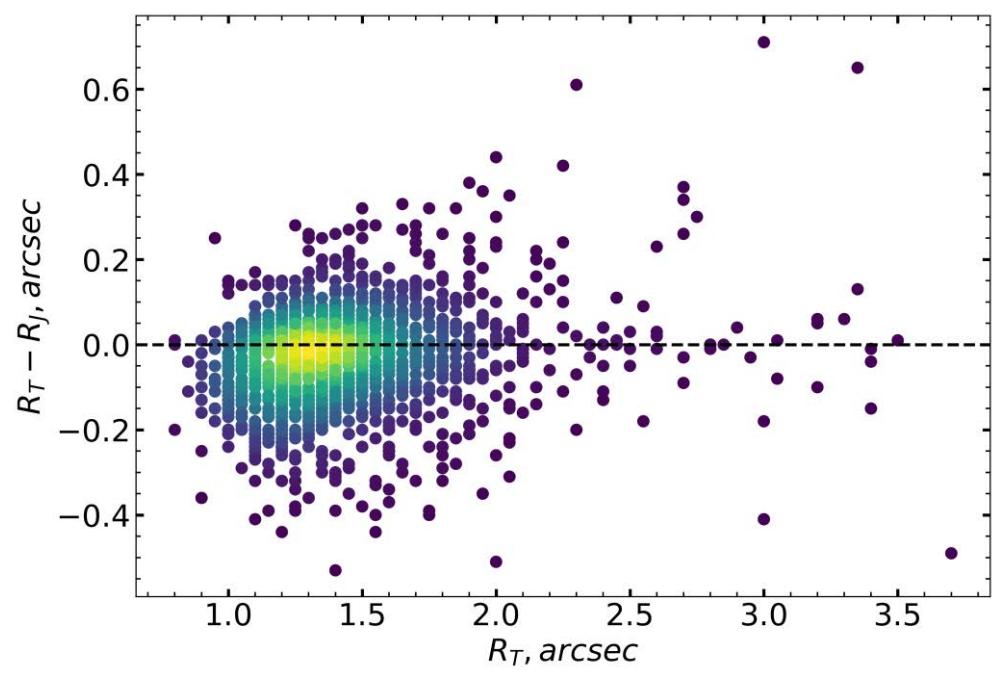
The aim of this study is to perform an aperture photometry of the M31 star clusters in a colour-consistent way. For this purpose, we analysed the sample of 1471 cluster. New centre coordinates, apertures, and background levels are determined. We use a two-aperture approach: "total" and "colour" apertures in order to perform cluster photometry. The "colour" aperture is used to obtain an accurate cluster colour indices by avoiding bright field stars, the "total" aperture measures a total cluster magnitude. In Fig.1 "total" aperture sizes are compared with ones applied in [1]. Negative values indicate that we reduced aperture in order to exclude contaminating stars; positive values show that we increased aperture for star clusters in dense regions, globular clusters, and stellar associations. New centre coordinates are determined for 90% of star clusters. Our study demonstrates that by applying a new method of cluster photometry, we improve photometric accuracy of the Andromeda star cluster measurements.