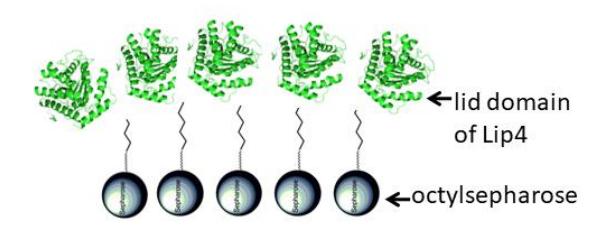
At present, enzymes are the key players in different industrial processes with microbial lipolytic enzymes being one of the most widely used in biocatalysis, both at academic and industrial levels. However, for the industrial implementations, especially in organic synthesis, immobilized enzymes are preferred over their soluble forms because of their reusability, greater activity, specificity, stability, resistance to inhibitors and in some cases even purity [1]. Immobilized preparations are more suitable for the biocatalysis in organic media. Immobilization may improve enzymes rigidity which can lead to higher stability in organic media and, therefore, such enzyme preparation maintains not only high residual activity, but also can exhibit improved thermostability and substrate specificity [2]. Unfortunately, ready-to-use immobilized preparations of lipolytic enzymes suitable for the synthesis of the desired compounds do not always exist and/or usually have a high cost. Therefore, in the present study, we aimed to find effective way of immobilization of different lipolytic enzymes for the use in organic media. So far, two enzymes were selected for the study: a novel recombinant Lip4 carboxylesterase from S. saprophyticus AG1 and a chimeric lipolytic enzyme (made of Theromyces lanuginosus lipase and Fusarium oxysporum phospholipase A1) Lecitase Ultra (Novozymes). The former enzyme-coding gene (lip4) was cloned and expressed in E. coli C41 (DE3) and purified using affinity chromatography. Lip4 and Lecitase Ultra were immobilized utilizing adsorption immobilization on octylsepharose (OS). Adsorption immobilization was chosen since lipolytic enzymes have a hydrophobic lid domain and this unique structural feature can be used to "lock" the enzyme in active form by immobilization on hydrophobic supports, which mimic the hydrophobic substrates of enzymes [3] (Fig. 1). Immobilization of Lip4 and Lecitase Ultra on OS have shown that compared to free enzymes, both Lip4 and Lecitase Ultra possessed higher activities indicating their hyperactivation upon immobilization. However, for the further synthesis of valuable flavor esters (2-phenylethylbutanoate and 2-phenylethylpropanoate) immobilization requires further studies in selecting the optimal conditions for each enzyme.