The phenomenon of superconductivity in high-temperature superconductors (HTSC's or cuprates) can be understood by studying HTSC's properties in the normal state, which are well known to be very peculiar. The most intriguing property is a pseudogap (PG) observed mostly in oxygen deficient cuprates below any representative temperature $T^* \gg T_c$ [1]. At present, it is believed that the proper understanding of PG physics has to offer the possibility to decipher the basic pairing mechanism in the HTSC's which still remains uncertain.
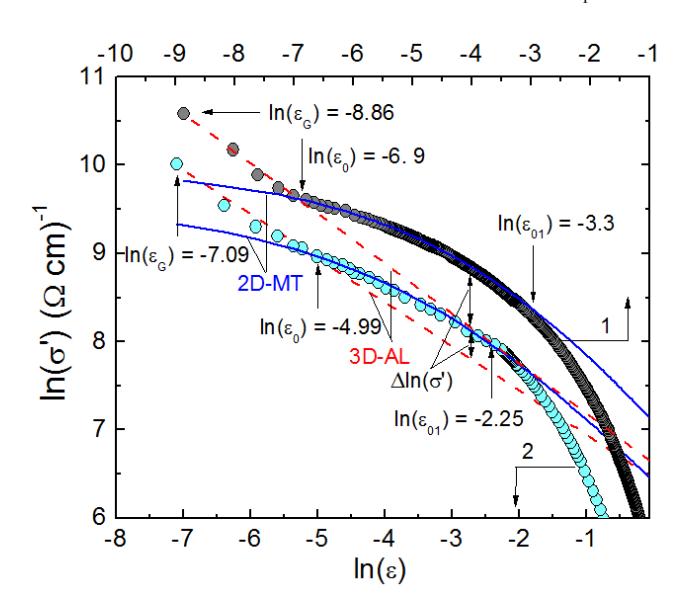
The effect of 2.5 MeV electron irradiation on the temperature dependences of the resistivity $\rho(T)$ of an optimally doped YBa2Cu3O7-δ single crystal has been studied. Here we show that with an increase in dose $\phi$, the value of $\rho(300K)$ increases linearly, while Tc decreases linearly. The value of $\rho(100K)$ increases nonlinearly, demonstrating a feature for $\phi = 4.3 \cdot 10^{18}$ e/cm2, which is also observed on the number of other dose dependent parameters. Regardless of the irradiation dose, in the temperature range from Tc up to T01, the excess conductivity $\sigma'(T)$ obeys the classical fluctuation theories of Aslamazov - Larkin (3D-AL) and Maki-Thompson (2D-MT), demonstrating 3D-2D crossover with increasing temperature. The crossover temperature T0 makes it possible to determine the coherence length along the c-axis, $\xi_c(0)$, which increases by $\sim 2.6$ times under irradiation. Furthermore, the range of superconducting fluctuations above Tc also noticeably increases. At $\phi = 0$, a "classical" pseudogap dependence $\Delta^*(T)$ is observed with a maximum at Tpair $\sim 120$ K and a clear minimum at T = T01 [2]. It was determined for the first time that at $\phi = 4.3 \cdot 10^{18}$ e/cm2 the shape of $\Delta^*(T)$ changes strongly and becomes the same as in optimally doped YBa2Cu3O7-δ single crystals with defects, which is accompanied by a sharp decrease in Tpair and the pseudogap opening temperature T*, while at Tc($\phi$) there are no singularities. With an increase in the irradiation dose up to $\phi = 8.8 \cdot 10^{18}$ e/cm2, the shape of $\Delta^*(T)$ is restored and becomes the same as in well-structured YBa2Cu3O7-δ films. Moreover, in this case, Tpair and T* increase noticeably.