
Starch is a natural carbohydrate based polymer, which is widely available from various natural sources including potato, wheat and corn. The granules occur in all shapes and sizes, i.e. spheres, ellipsoids, polygons, platelets and irregular tubules. Their diameter is ranging from around 0.1 to 200 μm depending on botanical origin [1]. Cross-linking occurs when intermolecular bridges are introduced between polysaccharide macromolecules. Cross-linked starches are resistant to high temperature, low pH, and higher shear, and the viscosity and textural properties are changed compared to native starch e.g. the hydrogen bonds in cross-linked granular starch are stronger and preventing swelling of the granules during pasting. The purpose of this work was to evaluate the starch cross-linking with epichlorohydrin process, taking into account the botanical origin, granule size and suspension concentration of starch in order to optimize and predict the cross-linking process.
Potato, wheat or corn starch was mixed with a sodium hydroxide solution and crosslinking agent epichlorohydrin (EPI) at the molar ratio of the AGU : EPI : NaOH : H2O was 1 : (0.0005–0.01) : (0.0025–0.012) : 10. The reaction mixture was maintained at the temperature of 45°C for 24 h and pH 10.
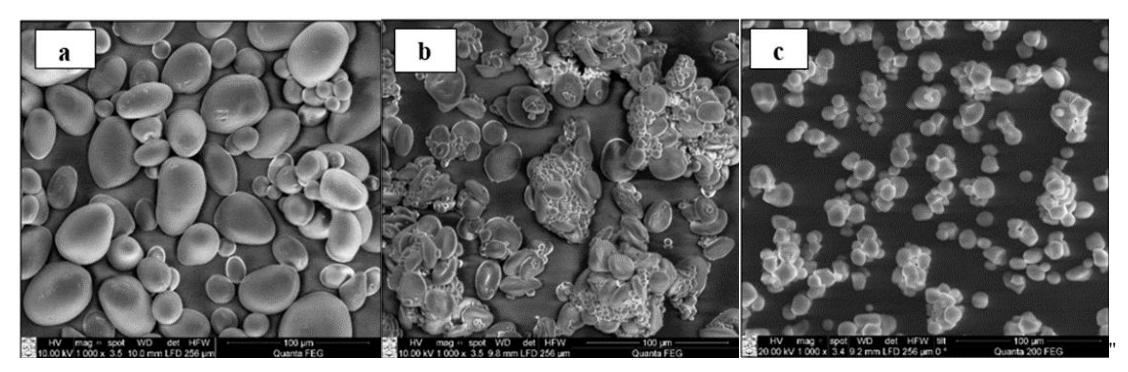
As the size of the granules is of great importance in starch modification reactions, the particles were first characterized by scanning electron microscopy (SEM) (see Fig. 1) and laser diffraction techniques.
As it is known from literature data [2], starch molecules are highly soluble in 1 M KOH aqueous solution, therefore this solvent was used to investigate synthesized cross-linked starch derivatives. By increasing EPI concentration in the modification mixture, the solubility of the obtained samples decreased due to the formed cross-links between macromolecules. It has been observed that even very small amounts of cross-linking agent have reduced the solubility of native starch by 15-30%, implying that not only grafting reactions but also cross-linking of macromolecules is taking place. The viscosity changes of the suspensions of starch derivatives were determined by using viscoamylography technique. The lower viscosity was characteristic of the suspensions of wheat and corn starches composed of small granules, meanwhile, the peak viscosities of the slurries of potato starch-based samples composed of large granules were much higher. By selecting tailored starches and amounts of cross-linking agent, the materials with perfect thickening properties can be obtained. Meanwhile, cross-linked starches obtained by using 0.01 mol of cross-linking agent per 1 mol of starch do not form gels during pasting and remain in water in the form of microparticles. Therefore, such derivatives could be also potentially used as sorbents.