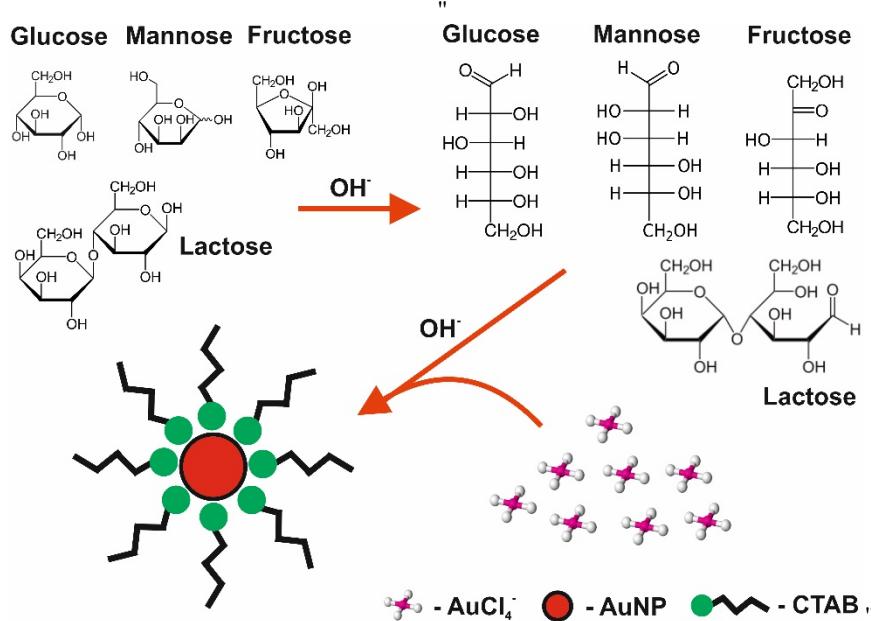
Reducing sugars are found in abundance in the food that we eat every day. Since overconsumption of sugars can be related to various diseases such as diabetes, obesity, heart disease, and various other disorders, the monitoring of reducing sugar levels in food and other mediums is an important task [1]. As such, sugar detection methods are being constantly improved seeking simpler, cheaper, and more accurate detection. Currently nanomaterials play and important role for reducing sugar detection acting as analytical signal providers or being used for analytical signal amplification, for example, in order to improve electron transfer kinetics, increasing sensitivity, reproducibility, and stability of the sensors [2]. Gold based nanomaterials (AuNP) are the most well-known, understood, and used optically active nanomaterials. Regarding their unique physical and optical properties AuNPs have been extensively employed in different analytical systems to strengthen existing signals, or as a separate signal in itself [2, 3]. For example, the formation of AuNPs, induced by reducing sugars, can be used as an analytical signal [4]. Sensors that use the formation of nanomaterials as signals can have unique analytical parameters since the analytical signal is governed by nanomaterial synthesis kinetics allowing for sophisticated analysis of similar analyte mixtures. Due to AuNP optical properties simple detection methods such as UV-vis spectroscopy can be employed to monitor AuNPs formation resulting in a fast and non-destructive detection.
In this work the formation of AuNP resulting from an oxidation-reduction reaction of HAuCl4 in the presence of reducing sugars was used for the development of an optical sensor. Optimal oxidation-reduction reaction conditions were determined. The developed analytical system was evaluated with model samples of glucose, fructose, galactose, lactose, and mannose as well as reducing sugar mixtures. The impact of AuNP formation kinetics on the analytical parameters was established. Additionally, the developed system was tested with real samples.