
The direct transitions from 3PJ (J = 0, 1, 2) or 1D2 excited levels to the ground states (3HJ) results in sharp lines in the Pr3+ emission spectra. Besides, in some host matrices, the energy migration from 3P0 to 1D2 levels can be observed yielding exclusively red emission [1]. In our studied host matrix, namely, K2Bi(PO4)(MoO4), only intraconfigurational (4f → 4f) transitions were observed. Also, cross-relaxation processes are very common in inorganic materials doped with trivalent praseodymium ions and this process is responsible for the emission quenching, especially as a function of dopant concentration. The cross-relaxation process can be directly measured by examining the fluorescence intensity decay after the pulsed excitation.
For the aforementioned reasons, Pr3+ doped K2Bi(PO4)(MoO4) synthesis and optical measurements were performed. Moreover, the luminescence properties of rare-earth ions are determined by their environment in the host lattice. In most cases, molybdate based compounds are used as luminescent ion hosts in order to obtain well-defined emission properties [2].
In this research, the K2Bi(PO4)(MoO4):Pr3+ phosphors were prepared by a solid state reaction method at relatively low temperature (873.15 K). The optical properties of synthesized samples were consistently studied as a function of Pr3+ concentration and temperature. The given presentation will include XRD and SEM measurements, reflection, excitation, emission spectra, PL decay curves, luminous efficacies at room temperature; and emission spectra, PL decay curves, as well as CIE 1931 color coordinates in 77 – 500 K temperature interval.
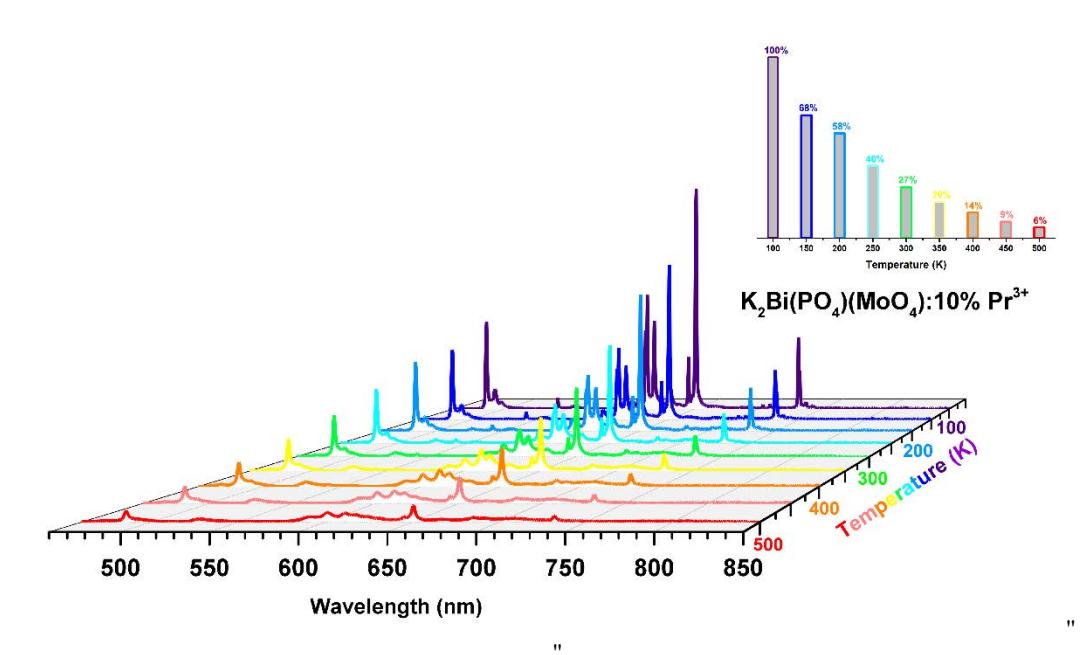
The thermal quenching behavior for the sample doped with 10% Pr3+ ions is shown in Fig. 1. The inset of this figure represents the integrated emission intensity at different temperatures which obviously decreases when the temperature increases. It was observed that PL intensity decreases exponentially with increasing temperature. Low (100 K) temperature emission spectra are dominated by 3P0 → 3H4, 1D2 → 3H4, 3P0 → 3H6 and 3P0 → 3F4 transitions. However, when temperature was increased to 500 K all transitions from 3P0 and 1D2 almost disappeared. This feature is expected, because of cross-relaxation and 1D2 level is absolutely vanished in non-radiative pathway, and only emission from 3P0 → 3H4, 3H6, and 3F4 transitions at 590 nm, 601 nm and 740 nm are seen in the spectra at 500 K temperature.
Finally, our determined optical features show possibility to use synthesized materials in display and security pigments industry.