
Knitted fabrics are preferred for clothing due to their outstanding comfort. Knitted fabrics featuring with the antistatic properties are increasingly used for smart textile applications due to their flexible nature [1]. Nowadays knitted fabrics are also widely used for composite materials applied in automotive engineering, in civil engineering, etc. [2]. Mechanical properties of knitted fabrics are highly important when choosing mostly suitable one for a particular application.
1×1 rib knitted fabrics were developed by using the yarns of four different blend ratios of cotton fibers and antistatic fibers made from polyester containing carbon particles. Fibers blend ratios in the used yarns were these: 90 % cotton/10% antistatic polyester, 80% cotton/20% antistatic polyester, 70% cotton/30% antistatic polyester, and 65% cotton / 35% antistatic polyester. A fully automatic flat knitting machine MATSUYA-M100 with 14 gauge was used for sample development. Thickness of all the investigated fabrics ranged within the limits of 1.87–1.90 mm, wale density - 14.6-15.8 cm-1, and course density – 10.6–11.6 cm-1. These structure characteristics were determined according to the standards LST ISO 5084 and LST EN 14971, respectively. Area density w of the tested fabrics was determined according to the standard LST EN 12127. The area densities of the investigated textiles were 598 g/m2 for MR1 fabric, 578 g/m2 for MR2 fabric, 566 g/m2 for MR3 fabric, and 511 g/m2 for MR4 fabric. Bending lengths L of 50×150 mm rectangular specimens cut from the investigated knitted fabrics were measured applying a cantilever method with the FAST-2 bending meter. Fabric bending stiffness B was calculated by using Eq. (1):
$$B=w c^3 \times 9.81 \times 10^{-6}\tag{1}$$where B – bending stiffness, μNm; w – area density, g/m2; c – half of bending length L of the tested specimen, mm.
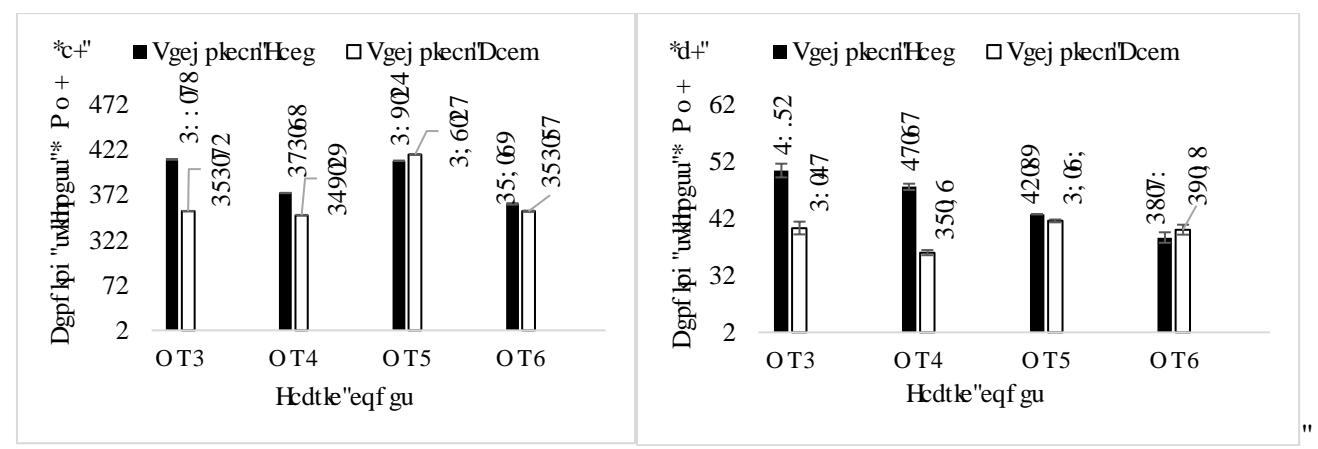
Bending stiffness of 1×1 rib knitted fabrics was found significantly higher in fabric wale direction (Fig. 1, a) than in course direction (Fig. 1, b), supposedly, due to the higher fabric density in wale direction influencing its higher capability to withstand the stress. A decreasing tendency of the bending stiffness of the investigated 1×1 rib knitted fabrics was related with the decrease in their area densities [3] as well as with the increase in the antistatic polyester percentage in fabric structure, especially for MR3 and MR4 knitted fabrics [4].
When summarizing up the research results, it can be seen that the bending stiffness of knitted fabric is highly dependent on the fabric direction. Area density of the investigated knitted fabrics makes significant influence as well. Higher percentage of the antistatic polyester fibers in fabric structure influences its lower stiffness.