
Compared with traditional forms of electricity production, photovoltaic technology offers us the possibility to produce green and sustainable energy and reducing emission of greenhouse gasses and other toxic or harmful particles. A great deal of effort has been made during the past few years to improve the performance of perovskite solar cells (PSC) by optimizing the device structure, composition and morphology of the perovskite layer, as well as synthesizing and applying more efficient electron (ETM) and hole transporting materials [1]. As a result, PSC conversion efficiency (PCE) reached 25.5 % [2], which makes PSC quite promising photovoltaic technology. However, stability issues remain as a main obstacle, hindering commercialization of PSCs.
For inverted PSCs, fullerenes and their modified derivatives are widely used as ETMs, among which PCBM is the most prevalent one. Unfortunately, limited solubility of non-modified fullerenes in organic solvents hinders their applicability in PSCs, while modified ones are rather expensive [3]. Efficient method to improve the performance and stability of PSC is to coat perovskite with derivatives, able to form self-assembled monolayers (SAM), e.g. ETM SAM. The ionic nature of the perovskite layer capable of interaction with different anchoring groups, by forming coordination or ionic bonds. Therefore, SAMs can form ordered one-atom thick layer with well-defined orientation on the perovskite surface. The layout of directed ETMs molecules maintain constant dipole moment, which influences charge transporting efficiency and the alignment of energy levels at the layers interface. Incorporating particular functional groups, which provide hydrophobicity, into SAM molecular structure, e.g. fluorine atoms, can also improve perovskite resistance to moisture [4].
In this work new n-type semiconductors containing 1,4,5,8,-naphtalenetetracarboxylic diimide (NDI) central fragment along with various anchoring and protective groups were synthesized.
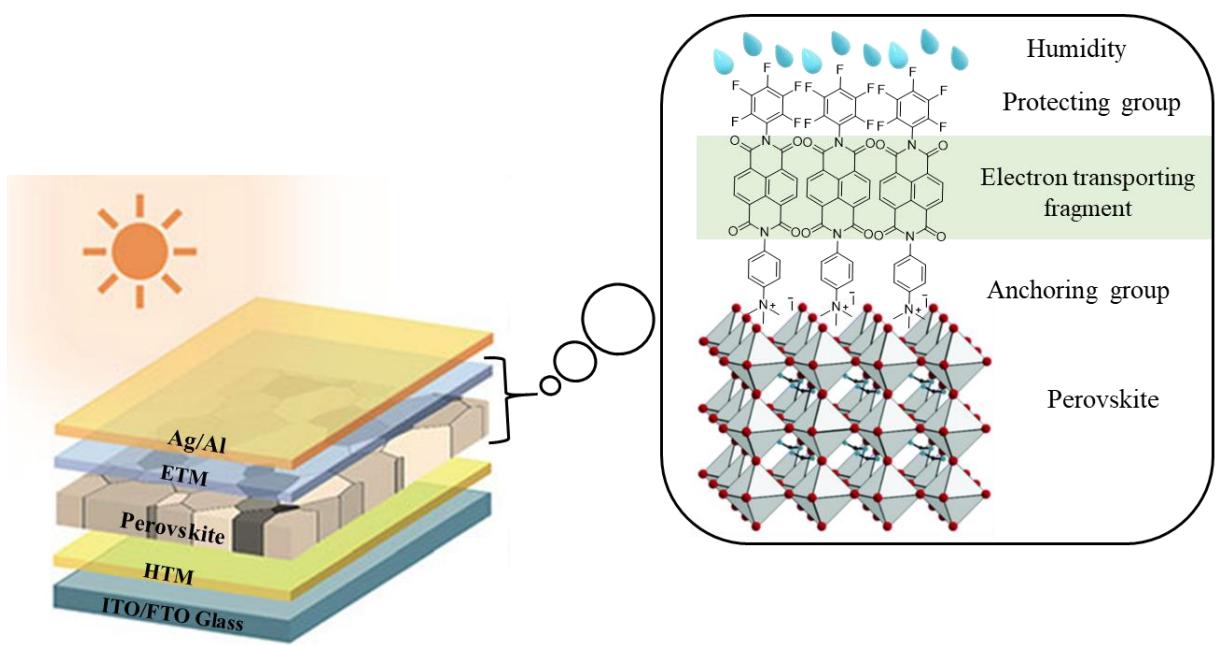
Photoelectrical, optical, thermal properties of the synthesized compounds were investigated and different monolayer forming procedures were tested. SAMs with pentafluorphenyl fragments formed the most hydrophobic layer on the surface of perovskite, which has improved moisture resistance of the perovskite. Additionally, using synthesized ETMs perovskite solar cells were constructed and photovoltaic characteristics of these devices were measured.