
Mitochondria are key cellular organelles that play an essential role in various functions such as regulation of cellular metabolism, redox signaling, ionic homeostasis, and cell death [1]. Since tumorigenesis requires flexibility for the tumors to adapt to cellular and environmental alterations, it is not surprising that mitochondria serve a key role in this process [2].
Previously, a series of indole-containing steroids were synthesized: N-(2-(3-indolyl)ethyl)-3β-hydroxyandrost-5-en-17β-amine (IS-1), N-(2-(3-indolyl)ethyl)-3-hydroxyestra-1,3,5(10)-trien-17β-amine (IS-2) and two 20-epimers of N-(2-(3-indolyl)ethyl)-3β-hydroxypregn-5-en-20-amine (IS-3). These compounds were shown to decrease C6 glioma cell proliferation in 10 μM concentration [3], as abiraterone acetate (Abi) anticancer agent did. To examine indole-containing steroid intracellular effects, we investigated the mitochondrial membrane potential (MMP) of C6 glioma cells.
Cells were cultured in DMEM/F-12 medium at 37°C in a humidified 5% CO2 and 95% air atmosphere. On the third day of growth cells in suspension in HEPES-buffer were incubated with tetraethylbenzimidazolylcarbocyanine iodide (JC-1, 2 μM) for 30 min at 37°C, membrane potential was measured by by spectrofluorimetry. Mitochondrial inhibitors Rotenone (Rot) or Antimicina A (Ana) were added after incubation with JC-1.
We found that Abi at 10 μM decreases the MMP by $62\pm15\%$, whereas IS-3R does so by $40\pm25\%$ (Fig.1 A). IS-1, IS-2, and IS-3S did not affect the MMP. Simultaneous treatment with complex I inhibitor rotenone (Rot) and Abi, IS-1 or IS-3R led to an additional decrease of MMP (Fig.1 B). IS-1 and IS-3R lead to the minor recovery of MMP after inhibition of the third complex by Ana (Fig.1 C).
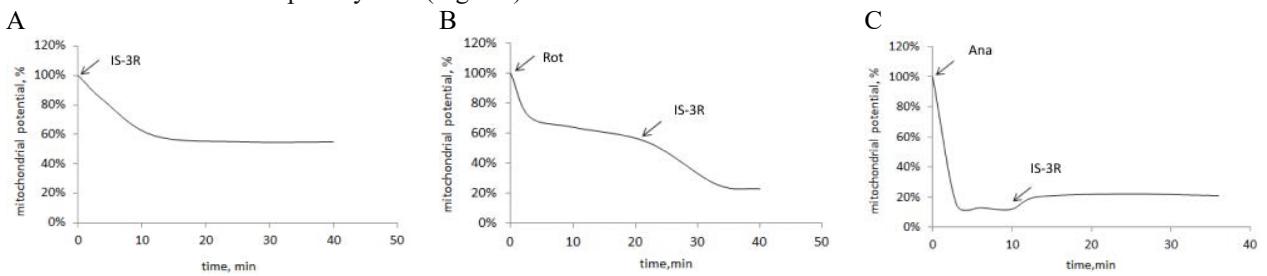
Although IS-1 is an effective inhibitor of glioma cell proliferation [3], we did not detect it to influence the MMP, contrary to abiraterone, a known apoptosis inducer [4]. The observed effect of the indolesteroid IS-3R on MMP could be related to its interaction with mitochondria on complex III level. Further investigations are underway to examine if apoptosis is involved in indolesteroids' effect on C6 glioma proliferation.