
Lactic acid is an important platform chemical used in food, agriculture, cosmetic, pharmaceutical, and chemical industries. In addition, optically pure forms of this acid (L- and D- stereoisomers) are essential for the production of polylactic acid, a biodegradable polymer that has potential to replace traditional petroleum-based plastics and reduce environmental pollution. Naturally, lactic acid, as a primary fermentation product, is produced by a number of microorganisms including lactic acid bacteria (L. lactis, L. paracasei, E. hirae), Bacillus species (B. coagulans, B. subtilis), and filamentous fungi (R. oryzae). However, in order to achieve technologically and economically sustainable production, the complex selection for best producing bacterial strains and multifactorial process optimization are often required. Fortunately, high-throughput technologies based on whole-cell genetically encoded biosensors show great potential to facilitate and drive the multifaceted screening process.
Recent studies have shown that transcription factor (TF)-based biosensors can be used for real-time monitoring of extracellular and intracellular metabolite concentrations, high-throughput screening of vast mutant libraries, dynamic pathway control, and adaptive laboratory evolution [1, 2]. The design of the biosensor is based on two essential components: sensing and reporting units. The sensory module consists of TF-promoter pair that is in an inducible gene expression system and responds to the corresponding ligand molecule. Reporting unit typically consists of the fluorescent protein and is coupled to the sensing unit, so that changes in the sensory block change the output [3].
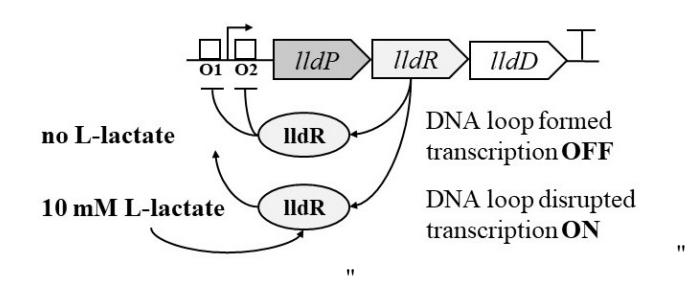
A few lactic acid-inducible gene expression systems have been reported previously in various microorganisms, including EcLldR/PlldP (E. coli MG1655) [4], CgLldR/PlldP (Corynebacterium glutamicum ATCC 13032) [5], PaLldR/PlldP (Pseudomonas aeruginosa XMG) [6], BcLutR/PlutA (Bacillus subtilis 168) [7], DvLurR/PlupR (Desulfovibrio vulgaris Hildenborough) [8], and AwLctA/PlctB (Acetobacterium woodii DSM 1030) [9]. The basic regulation mechanism of L-lactic acid-inducible gene expression system from E. coli is presented in Fig. 1. This system controls, an lldPRD operon, responsible for aerobic L-lactate metabolism. We identify and characterize L- and D-lactic acid-inducible systems that can potentially be used for developing transcription factor-based biosensors. Our data show that the EcLldR/PlldP inducible system is specific to the L-lactic acid and can be used to achieve up to 25-fold induction of gene expression using micromolar inducer concentrations.