Radiocarbon (14C) is a long-lived carbon isotope that has a half-life of 5730 ± 40 years. Nuclear power plants are one of the main producers of anthropogenic radiocarbon. Anthropogenic radiocarbon can be released into the environment in gaseous forms, with liquid releases or with spent nuclear fuel. Despite this pollution is not significant in the sense of population exposure doses, but it is a significant 14C increase above background effect that allows the use it as an anthropogenic contamination tracer to study the dissemination, accumulation, and dynamics redistribution processes of the pollutant in ecosystem [1].
The lake sediment and fish scale samples were collected from the Druksiai lake. The lake water was used to cool the reactors of the Ignalina nuclear power plant (INPP). ABA (acid-base-acid) chemical pretreatment procedure was used to extract humin (HM) and humic acid (HA) fractions from the sediments (from two different lake sediment columns). Radiocarbon measurements in these samples were performed using the accelerator mass spectrometer (AMS).
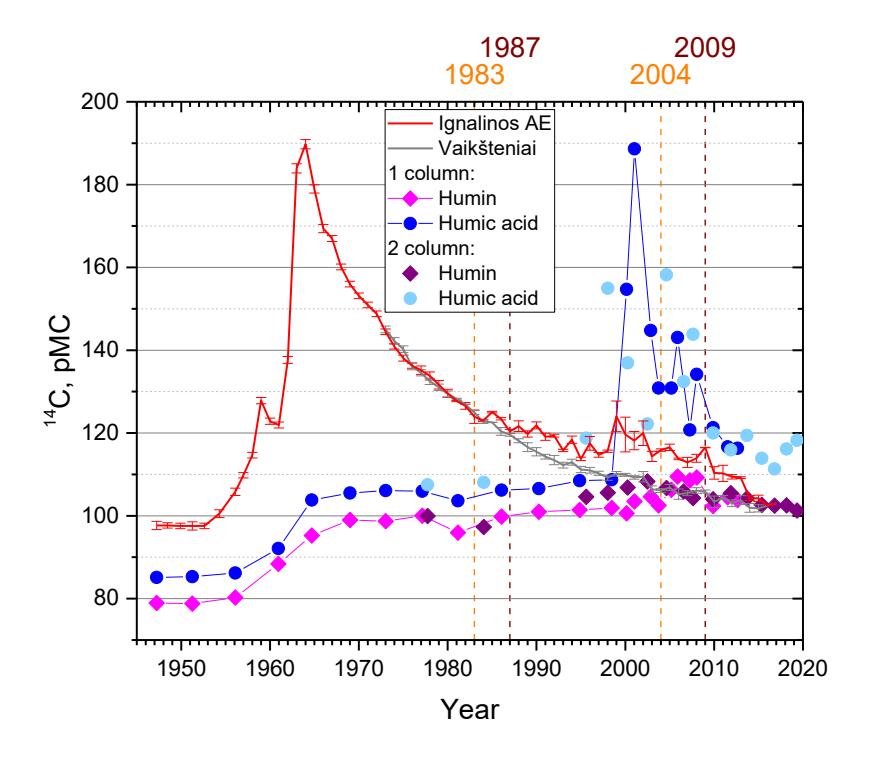
14C measurements in humin and humic acid fraction have shown that atmosphere-lake CO2 exchange accounted for about 22% carbon in bottom sediments. During the 1983-1998 period, 14C-enriched dissolved inorganic carbon (DIC) was continuously released into Lake Druksiai. During that time, an average of about 0.24 GBq of radiocarbon was released per year. Measurements of radiocarbon concentrations in fish (both benthic and pelagic) confirm that the 14C contamination was in dissolved inorganic form.
Around 2000, 14C-enriched DIC (2.3 GBq radiocarbon) was released into Lake Druksiai from Ignalina NPP. Furthermore, organic compounds were additionally released in the same year. These compounds were not 14C-enriched but affected the interaction between humic and humic acids. After 11 years after the end of the INPP operation, the concentration of radiocarbon in the bottom sediments is higher than in the atmosphere.