
Solid solutions of trifluorides rare-earth elements (REEs) in the form of powders, ceramics, single crystals and nanomaterials are currently being intensively studied since they often surpass the corresponding chlorides and bromides in many properties. They can be used as materials for lasers, scintillators, phosphors, displays, light sources, catalysts, ionic conductors, fibre-optic amplifiers, as well as biological labels, drug delivery agents. It is also known to use trifluorides for microelectronics, analytical chemistry, the technology of separation of elements, regeneration and purification of nuclear fuel.
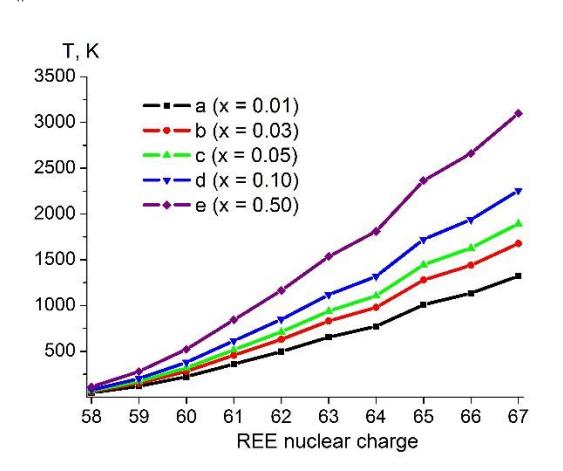
Using the crystal-chemical approach in the approximation of regular solutions, the mixing energies (interaction parameters) and decomposition temperatures of La1-xLnxF3 solid solutions, where Ln = Ce–Ho, are calculated. With an increase in the REE nuclear charge, the calculated mixing energies and critical decomposition temperatures of solid solutions regularly increase from 1.83 to 51.92 kJ/mol and from 110 to 3100 K, respectively, which is due to a decrease in the ionic radii of REEs in the series from Ce to Ho. It is shown that the total value of the mixing energy is determined mainly by the component caused by the difference in the sizes of the substituted structural units. The presented diagram (Fig. 1) for the La1-xLnxF3 systems, where Ln = Ce–Ho, makes it possible to estimate not only the thermodynamic stability, instability and metastability of solid solutions in a wide range of compositions and temperatures, but also to predict the limits of substitutions for limited series of solid solutions by a given decay temperature, or their decay temperature at a given substitution limit.
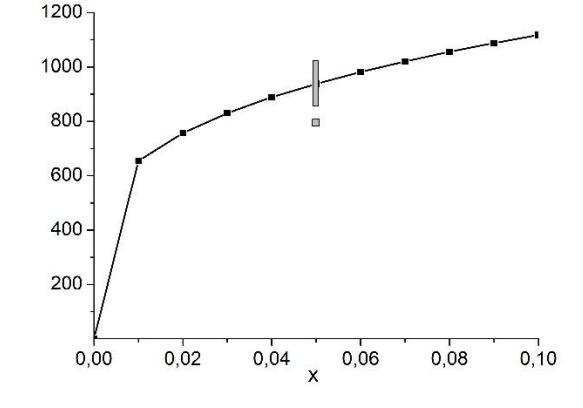
The calculation results for La1-xCexF3, La1-xPrxF3, La1-xNdxF3 systems do not contradict the experimental data obtained earlier by instrumental research methods in the sense that continuous series of solid solutions in these systems are in the predicted region of thermodynamic stability. The calculated decomposition temperature of the La0.95Eu0.05F3 solid solution (Fig. 2) is in satisfactory agreement with the experimentally found one [1]. The results of calculations of the mixing energies of the systems under consideration can be used to supplement their phase diagrams in the low-temperature region (to construct a dome of solid solution decomposition).