Bessel-Gauss beams have attracted much attention in laser micro-fabrication of transparent materials due to elongated focal zone and that is very attractive in various laser micro-machining applications where high width/depth ratio is needed. Compared to the Gaussian beam, the Bessel-Gauss beam is much more efficient in single shot micro-channel fabrication [1] or in cutting of various glasses up to a few millimeters thick [2]. Most commonly adapted Bessel-Gauss shaping element in lab is an axicon - a conical lens with sharp tip at the center. Despite the straightforwardness of axicon applicability, the element must have close to perfect shape quality, because any irregularities of its surface and especially a rounded tip greatly reduces the quality of the generated beam by inducing unwanted axial intensity modulations along the focal zone [3]. Some alternative beam shaping methods have emerged to substitute refractive axicons to increase the overall quality of the beam or create more complex patterns - from diffractive optical elements (DOEs), spatial light modulators to complex sub-wavelength metasurfaces [4, 5]. Freedom of choosing Bessel-Gauss beam generation method allows to fit in various specific beam shaping applications, thus the only limiting factors of element price or optical damage thresholds remain. Another type beam shaping element can be created by implementing birefringent nanogratings inscribed in bulk of fused silica [6]. Direct laser written nanogratings can have controllable retardance and orientation (fast axis) enabling to manufacture custom flat optical elements, usually named after geometric phase optical elements (GPOES).
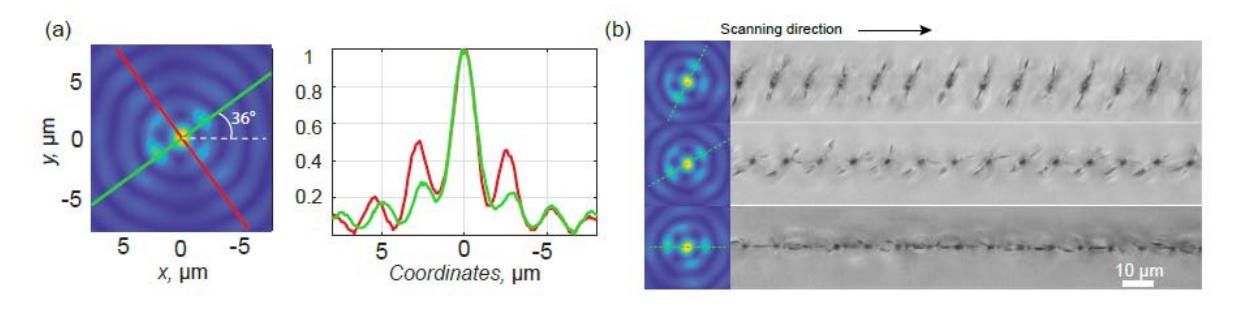
In this work we use geometric phase optical elements to create custom displaced phase axicons that form modified Bessel-Gauss beams (manufactured by Workshop of Photonics). With numerical simulation and experimental work, we present practical applications of the generated beams in transparent material laser micro-fabrication. Physical phase displacement allows to create new and fanciful patterns of Bessel-Gauss beams, varying from single elongated peak to multi-peaked intensity patterns. Taking advantage of high optical damage threshold of geometric phase optical elements, we demonstrate thin glass processing with high-peak power ultra-short pulse laser.