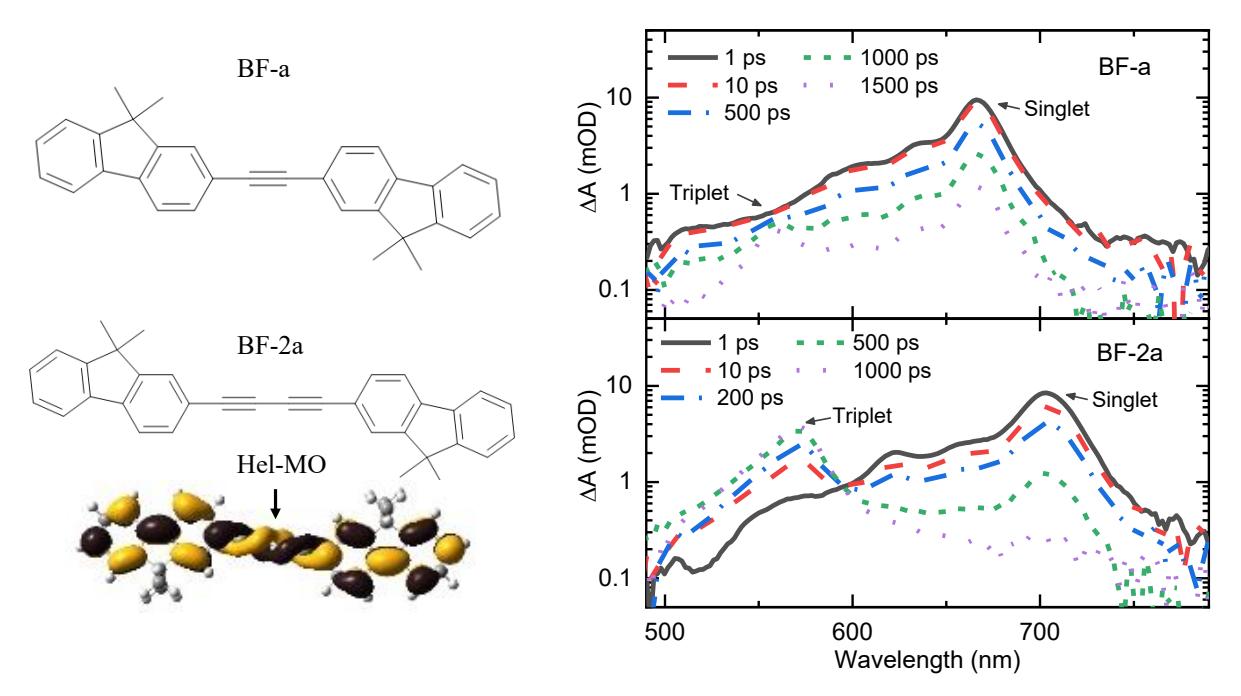
Compounds with strong spin-orbit coupling (SOC) and fast intersystem crossing (ISC) are important for organic light emitting diodes and photosensitizers used for photo-dynamic therapy [1]. However, achieving a high ISC rate usually requires heavy atoms, such as Pt or Ru, thus making materials of this kind not cost-efficient. Here, we propose a concept to enhance SOC in carbon-only structures by taking advantage of helical molecular orbitals (Hel-MOs). Intersystem crossing dynamics in bifluorenes were investigated by means of pump-probe measurements, which indicated that minor modifications of the molecule (extended alkyne bridge) cause considerable photophysical differences (Fig. 1). Furthermore, theoretical calculations were performed to confirm the helical shape of the MO in the dialkyne bridge unit. Formation of helical molecular orbitals results in enhanced SOC leading to an increased ICS rate.