
Bacterial vaginosis (BV) is one of the most common vaginal infections associated with impaired vaginal microflora that affects women of childbearing age. BV is associated with various adverse outcomes not only relating to women's fertility, reproductive health, or pregnancy, but also women's mental health [1]. Gardnerella spp. is the most associated bacterium with BV and has been detected in almost all vaginal samples from women suffering from BV [2].
Adhesins are cell-surface components that are responsible for the recognition of host cells and adhering to them. Studies on other bacteria show that various adhesins are proven virulence factors that are significant in bacteria's pathogenesis [3, 4]. However, the adhesins of bacterium Gardnerella spp. are very little studied and described.
After the amino acid sequence of Gardnerella spp. collagen adhesin (CNA) protein determination, a hypothesis was proposed that CNA allows Gardnerella spp. to bind to host extracellular matrix (EM) proteins.
The interaction between recombinant Gardnerella spp. CNA and selected EM proteins was investigated by various ELISA method variations and other immunochemical methods. Monoclonal antibodies (MAbs) against recombinant CNA protein were created using hybridoma technology. Anti-CNA MAbs were used to investigate the interaction between the CNA and EM proteins: type I, III, IV collagens, fibronectin, and fibrinogen. Using indirect ELISA method we detected that CNA interacts with all EM proteins used in the experiment (Fig. 1).
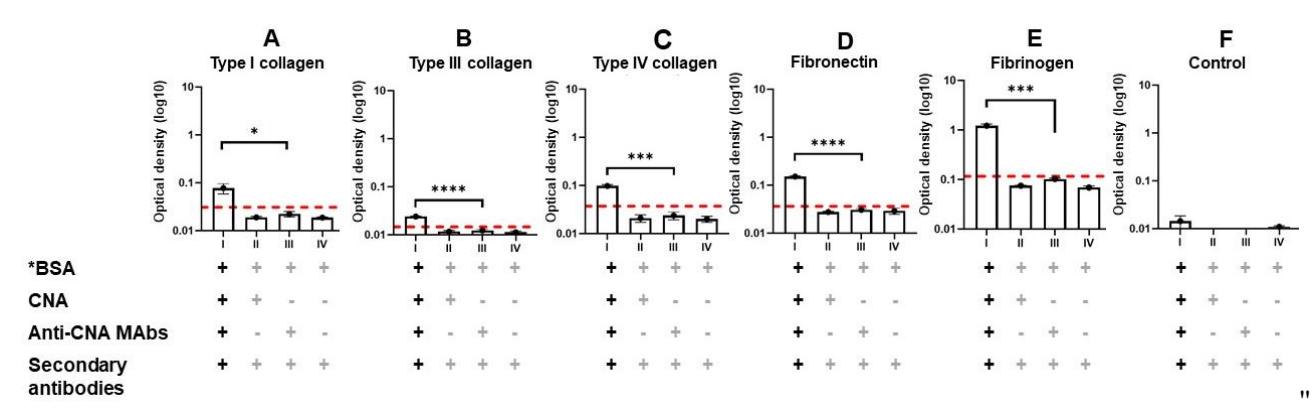
Results and created molecular tools, anti-CNA MAbs, raise new questions and hypotheses. In the future, we seek to use more complex model systems to investigate the interactions between native CNA and epithelial cells in vitro. This would allow to investigate and understand molecular Gardnerella spp. pathogenesis mechanisms.