
Microbial biostimulants containing nitrogen fixing microorganisms are perspective products which helps to reduce amounts of mineral nitrogen fertilizer on agriculture and the negative impact on the environment an human caused by the misuse of chemical fertilizers [1][2]. It is huge importance to select right microorganisms for microbial biostimulants production, microorganisms need to have positive effect on plants and should easy be applying on an industrial scale [3].
All thirteen isolates were screened by using different nitrogen free media. Phylogenetic analysis of 16S rRNA sequences showed that isolates belong for five different genus Bacillus spp., Paenibacillus spp., Ensifer spp., Rhizobium spp. and Lelliottia spp. The most intensive growth on nitrogen free media were showed two isolates S1 and S7 which both are members of Paenibacillus spp. (Fig. 1A).
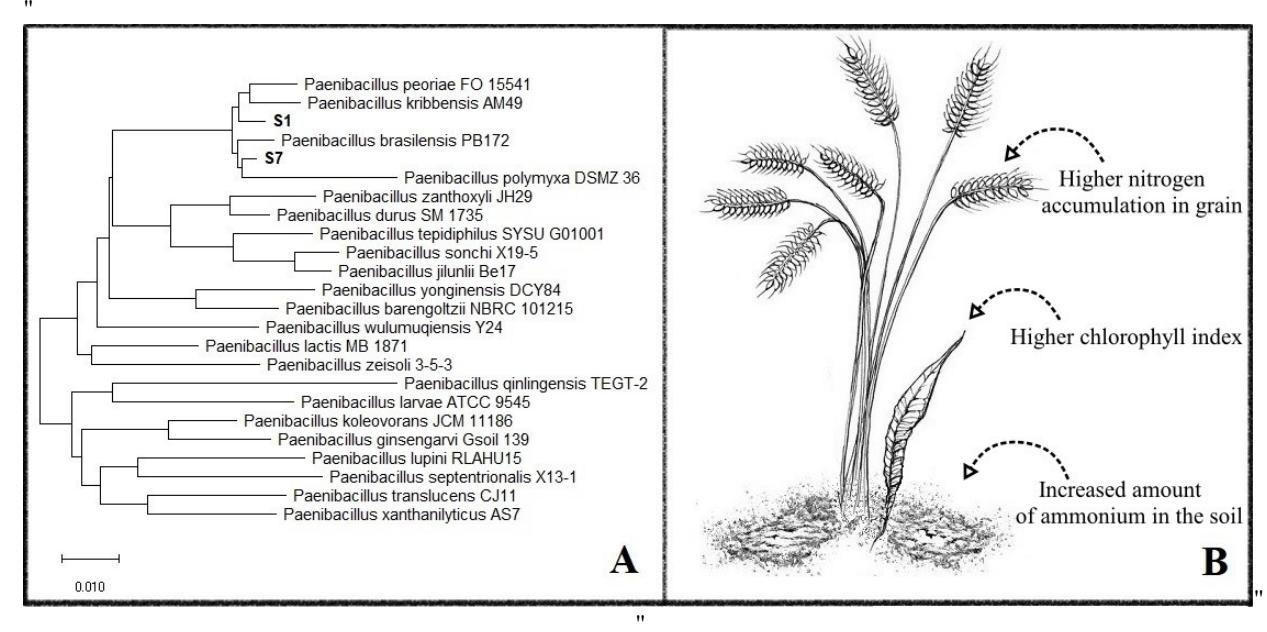
The impact of Paenibacillus sp. S1 and Paenibacillus sp. S7 isolates on the development and growth of spring wheat was analyzed. Isolate Paenibacillus sp. S7 was found to significantly increase the amount of ammonium in the soil, furthermore, positive effect on chlorophyll index and nitrogen accumulation in grain were determined (Fig. 1B). The most suitable nitrogen and carbon sources were founded for biomass production of Paenibacillus sp. S7.
See you in Vilnius!