
Since 1980, the development of additive production has begun. In recent years, several additive manufacturing technologies have been developed based on the creation of 3d objects using sequential layering processes. In such processes, the layers form a homogeneous structure by consistently coating 3d objects with properly prepared materials that can sometimes be modified during the process. This creates opportunities for the production of new unexplored structured materials.
One such technology is laser metal deposition technology (LMD) [1]. This additive manufacturing method, which generates 3D structures through the interaction of a laser beam, 3d objects and a gas powder stream. Most LMD systems use coaxial powder nozzles that form a conical powder flow. The position of the focal plan of such a powder flow affects the size, efficiency, and regularity of the sediment pathways [2,3].
To reduce the influence of the powder flow on the process, a new nozzle was developed to change the geometry from conical to cylindrical.
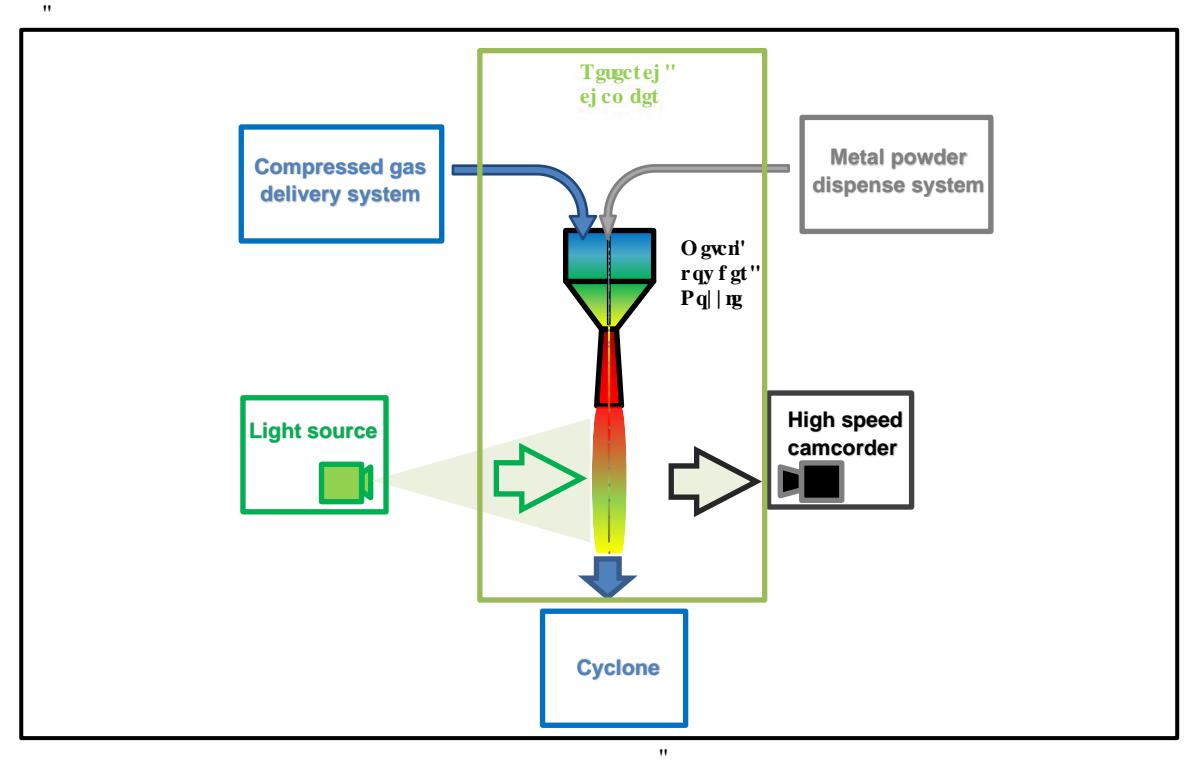
In order to control the process and increase its reliability and re-use in industry, it is necessary to know the exact characteristics of the metal powder nozzle.
In this study, we will investigate the fiber distribution of nozzle particles using different gas pressure values. The measurement setup is illustrated in Fig. 1. The results of the experiment will be determined using a fast video camera, pressure measurements, weighting methods to analyze gas and particle velocity, powder flow diameter, focal plan position, and density.