Oxidoreductases are enzymes that catalyze oxidation and reduction reactions in biochemical processes. They participate in glycolysis, citric acid cycle, oxidative phosphorylation, amino acid metabolism and in other vital biochemical transformations. Many of these reactions are interesting both from theoretical and practical perspectives. In industry, oxidoreductases are used as catalysts for synthesis of valuable products, biodegradation of pollutants, fabrication of biofuel cells and biosensors. Therefore, a better theoretical understanding of processes such as electron transfer (ET) catalysis of oxidoreductases provide routes for practical implementations.
Here we used glucose oxidase from Aspergillus niger (GOx) as a model enzyme to study ET between the active center of enzyme and a set of artificial electron acceptors. GOx catalysis cycle involves two separate reactions. In the first reaction, $\beta$-D-glucose is oxidized to D-glucono-$\delta$-lactone. In the second reaction, molecular oxygen, the natural second substrate of the enzyme, is reduced to hydrogen peroxide. According to the literature, the rate of this reaction is limited by ET [1, 2]. In addition, GOx can reduce a wide range of artificial electron acceptors, and in this study we investigated which process is the rate-limiting of reduction of these compounds.
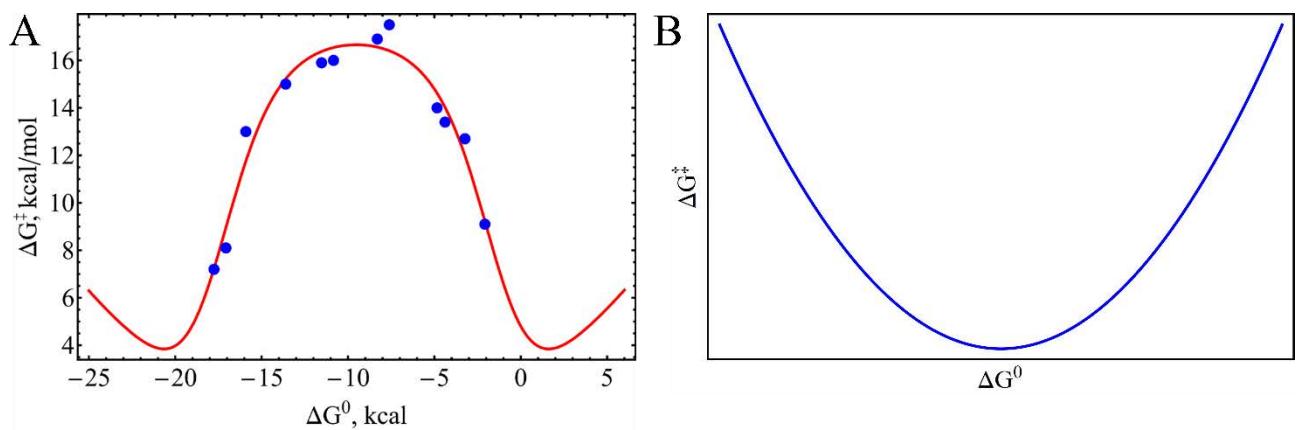
According to Marcus theory [3], when the reaction rate is ET-limited, then a parabolic relationship between natural logarithm of the reaction rate and free Gibbs energy exists [4,5]. However, this relationship is expected to hold only for a series of homologous substrates. A more generalized version of Marcus theory predicts a parabolic relationship between free energy of activation and free energy of a reaction (Fig. 1. B), without any assumptions about similarity of substrates. We measured these thermodynamic parameters for GOx catalyzed reduction reactions of 12 non-homologous artificial electron acceptors (Fig. 1. A, blue dots) and found a completely different relation than it is predicted by assuming ET as a reduction rate-limiting step. These observations could be explained by consecutive electron and proton transfer mechanism. In the case of this study, the reduction rate constants measured consist of both electron and proton transfer rate parameters. If ET is very fast, then the reaction rate is limited by proton transfer rate, and vice versa, if ET is slow, the reaction rate is limited by ET rate.