
Drying is one of the most popular and essential operations in the post-harvesting processing of medical plants or food products. During drying, the moisture from inside the product moves towards its surface, where it transforms to a gaseous state (water vapor) and then transfers to the surrounding air in terms of heat or mass transfer [1]. Contemporary food industry mostly uses drying methods that apply heat to induce the phase change of water from liquid to gaseous state [1, 2]. However, dehydration at high temperatures may influence the appearance, structure, and biochemical compound of dried specimen [3].
Our suggested method of drying does not involve the use of heat for dehumidification of drying air – the process initially occurs at room temperature. An operating principle of a created system is based on the dependence of relative humidity (RH) of air from its temperature. The air from the drying chamber is blown through a heatsink which is in thermal contact with a cold surface of a thermoelectric cooler (TEC). An immediate decrease of airflow temperature at this moment increases its RH; water vapor in the air reaches saturation point, and contributes to the formation of condensate, that should be collected and removed.
The workability of a proposed method was tested using computational fluid dynamics (CFD) software. The simulation was performed at following initial parameters: temperature of the air is 20.05 °C, RH is 65%, the air pressure is 101325 Pa, heatsink temperature is -2.15 °C, the volume of a drying chamber is 0.096 m3, total simulation time was 10 min with a step-up of 1 min. The simulation results in the form of cut plots presented at Figure 1.
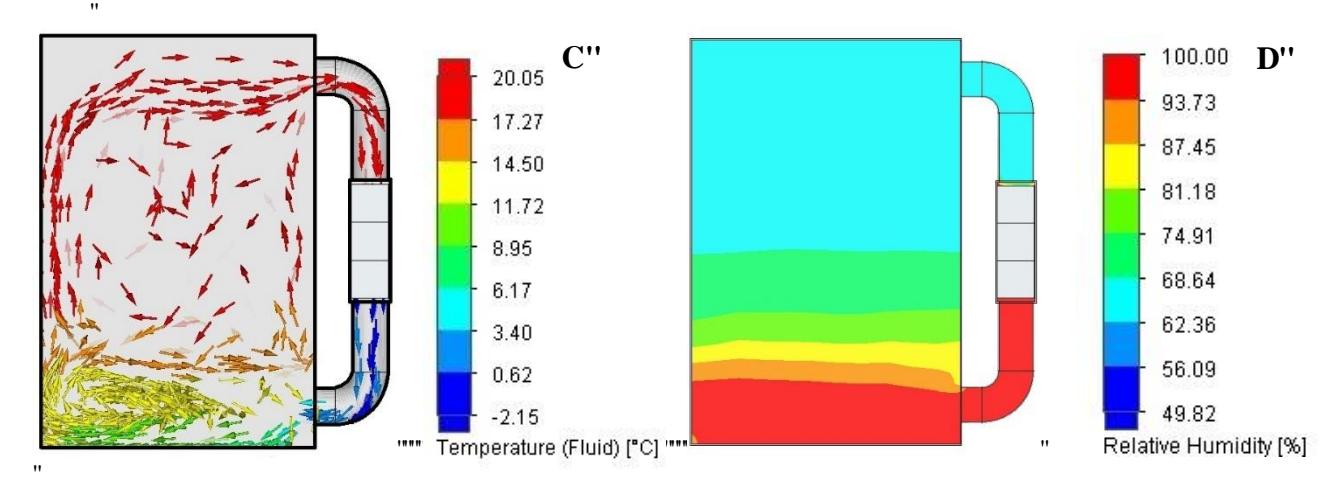
Correlation of RH and temperature plots (Fig. 1) demonstrates that the RH of air immediately reaches its maximum value when it passes through a cold heatsink and stays at that level until temperature increases to approximately 11 °C. Later, it gradually decreases as temperature rises. It means that the plant sample to be dried should be located in an optimal position between a minimal RH and maximal temperature zone.
Additionally, it is essential to note that RH change in the air stream, passing through the cold heatsink affects its temperature. Change of the heatsink temperature, required to induce moisture condensation – the dewpoint, could cause a decrease of the drying system efficiency. Higher temperature slows down the condensation process, too low temperature may lead to ice formation on the heatsink. Maintenance of highest system efficiency requires precise control of the heatsink temperature and its setpoint adjustments according to other system parameters. Definition of the optimal ratios between parameters affecting systems efficiency will become the main aim for further research.