
Quantum Dots (QDs) are fluorescent semiconductors, 1-100 nm in size, with unique optical and electrical properties [1]. Moreover, due to sensitivity of QDs spectral properties to environment, it is advantageous to use QDs as biosensors [2]. Also, as QDs already are used in many areas, it is possible that they may leak into the waterways and enter the food chain [3]. So, it is important to analyze the QDs photostability in aqueous or biological media to understand how different conditions effect their fate in the environment.
In this study, measuring an optical density and fluorescence of CdSe/ZnS-COOH QDs (625nm Invitrogen) in various aqueous and biological media under different light condition and temperature was assessed the photostability of QDs spectral properties. The samples of QDs with 4nM concentration were prepared in distilled, deep well, and lake waters, in MWC medium for growing algae, and with unicellular freshwater green Scenedesmus sp. and Chlorella sp. algae cells. After preparation of samples, they were kept at different conditions: in dark at +4 °C temperature, also in dark and under continuous white light (Osram Dulux Star, 11W/827) at about +20 °C temperature. The samples with algae cells were prepared with irradiated (violet light diode, 404 nm, 30mW/cm2, 120 min) QDs in deep well water (DWW) and kept in indirect sunlight.
Despite that, hour after the preparation of QDs samples, the photoluminescence (PL) intensity of QDs in deep well water was greatest compared of QDs samples in other studied media. During the period of 16 days, the PL intensity was the least stable in DWW, regardless of storing conditions (Fig. 1(a)). The QDs held under the white light had decreased PL intensity and shifted the peak of spectra to the red side of wavelength after a day compared with samples kept in the dark, where these spectral changes appeared later. This gives an indication that light might accelerate the aggregation of ODs. Regarding the fact that light had the strongest initial effect on spectral properties of QDs in lake water (the furthest shift of PL spectra to the red side) they were more stable under the continuous light than in dark over the time of experiment.
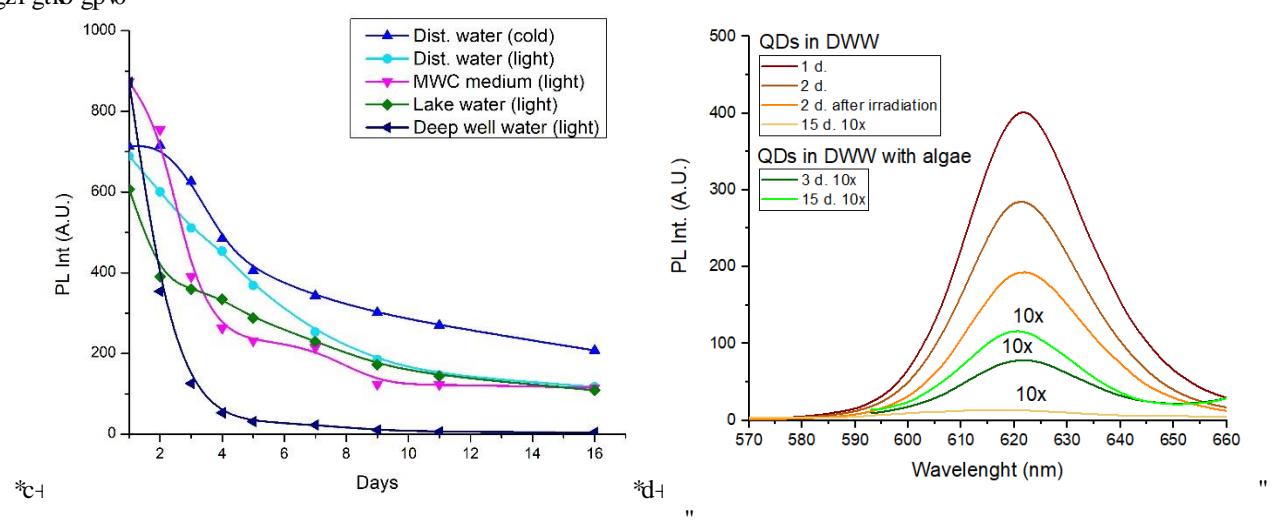
The PL intensity of QDs samples in deep well water after irradiation by violet light with 216 J/cm2 dose decreased most likely due to the partial disintegration of QDs coating, and kept decreasing during 15 days (Fig. 1(b)). The PL intensity of these QDs increased after addition of algae cells compared to the PL intensity immediately after irradiation. It seems that substances with algae cells had a partial restoring effect on the QDs coating, which was affected by the light.