
Optical coherence tomography (OCT) is an interferometric imaging method - widely used for retinal imaging - that can image deep in tissue. Compared to classical OCT systems where a single point detector is used to register the signal, full-field OCT (FF-OCT) systems utilize ultrafast CMOS cameras. Thus, the need to scan sample in both x and y directions is eliminated by obtaining an entire image at once. Low-speed mechanical scanning of interferometer's reference arm is replaced by swept source laser to enable registering multispectral interference patterns of the sample [1]. Fourier transformation of such acquired volume along wavelength yields real sample structure. This establishes principles of Fourier-domain (FD) FF-OCT.
We have built a FD-FF-OCT system, shown in Fig. 1, that consisted of a swept source laser (Broadsweeper BS-840-2-HP, Superlum), a Linnik interferometer and an ultrafast camera (Fastcam SA-Z, Photron). Spatial coherence was reduced with a specialized device (not shown in Fig. 1) to remove crosstalk coherent noise in the FF-OCT images.
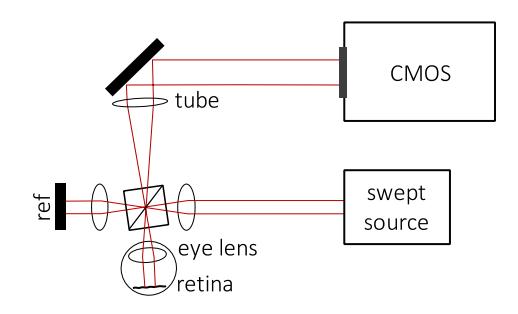
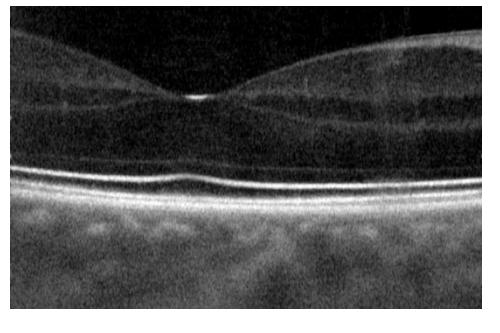
Fig. 2 shows a cross-sectional image of the human retina as acquired in vivo in the macular region. The whole volume was acquired in just 8.6 ms.
In conclusion, FD-FF-OCT provides increase of acquisition speed that significantly reduce image distortions induced by the natural eye movement [2].