
Current electronic devices and systems developed for remote communication (e.g. wireless/radio communication, electric power transfer, smartphones, tablets, and laptops, etc.) become sources of electromagnetic pollution. Although the harm to living organisms caused by electromagnetic pollution is still open to question, the electromagnetic pollution classified as potentially carcinogenic. The sources of extremely low frequency electromagnetic fields (< 300 Hz), intermediate electric fields (300 Hz – 100 kHz), radio frequency electric field (100 kHz – 300 GHz) are classified as sources of the electromagnetic pollution that influence living organisms making harm to their reproductive system [1], memory performance [2], oxidative stress [3], blood parameters and myocardium [4] etc. For these reasons, it is very important to understand the impact of electromagnetic pollution on living organisms, stay safe and protected from the potentially harmful effects and/or to leave as soon as possible unsafe of high power radiation environment.
The effect of electronic device's radiation on living organisms increases with increasing frequency [5] and decreasing distance to the source of radiation since the most efficient absorption of the radiant by radiation strongly absorbing bodies happens to be at $\lambda$-depth (here $\lambda$ is the wavelength of the electromagnetic wave). Therefore, the most dangerous for living organisms are radiation sources that come into direct contact with their body (e.g. smartphones, wireless headphones, Bluetooth devices) or appear to be located nearby (e.g. Wi-Fi routers, computer screens, microwave ovens, etc.) [6]. However, living in urban areas quite often we have no enough information about radiation sources (i.e. their exact location and radiation power) and therefore getting exposed to radiated electromagnetic waves.
We propose a method for detection of a location of an "unknown" radiation source of GHz frequency signals and demonstrate that it works well in the case of human living room if the source of radiation is located outside the living area. The radiation source (blue triangle in Fig. 1) set to radiate signals of fixed frequency ranging from 0 to 6 GHz. The power of radiation we measured by a detector (yellow circle) through moving it from one fixed position (blue circles) to another when the signals receiving antenna of the detector is located at different heights from the laboratory ground ranging from 0.4 m to 1.2 m. (Fig.1).
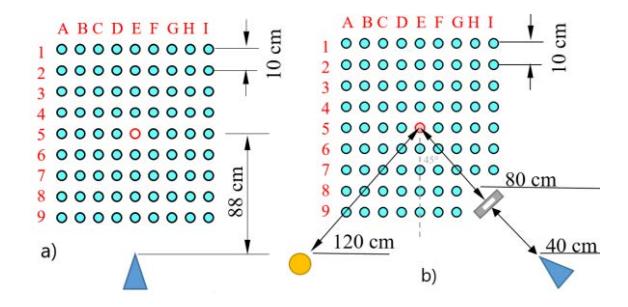
The experimentally measured radiation power verified through results of our calculations of the power rate using inverse distance square law helped us to recognize the presence of the "unknown" source of radiation, to determine its exact position (distance, height) in a room, and to estimate the magnitude of radiated power at various fixed positions in the room. The precision of the method depends on the signal-to-noise ratio and magnitude of the signals reflected from random surfaces of laboratory stuff and reaches the maximal value at the highest signal-to-noise ratio in the case when both the signals radiating antenna and the detector are located in an echo-free chamber.