
The Baltic Sea has been contaminated with anthropogenic radionuclides over a long history of nuclear energy use. Nowadays, the Baltic Sea continues to be contaminated with anthropogenic radionuclides due to the inflow of radionuclides from rivers with a total catchment area of about 2.106 km2. For example, the Vistula River brings about 1.6 GBq/y of 241Pu with its waters [1]. Moreover, the ingrown activity concentrations of 241Am are the result of ongoing radioactive decay of 241Pu. The activity of 241Pu in the Baltic Sea due to global fallout and the Chernobyl NPP accident are estimated at 39TBq (data [2] are corrected for 2021). The increase in the activity concentrations of 241Am will reach a maximum of 4.1TBq in ~ 47 years.
Particle-reactive radionuclides have over the years been a useful tool for studying the redistribution of various pollutants in the marine environment. It is known that many toxic organic substances, particularly chlorine-containing ones, easily bind sediments and are transported from land to the marine environment by rivers and coastal waters. Knowledge about the sources of radionuclides and understanding of their behavior are essential for their application in tracer studies. The aim of this study is to expand knowledge about the distribution of 241Am and 137Cs in bottom sediments of the Baltic Sea for their future applications in tracer studies.
The bottom sediment samples (Fig. 1) were taken by the Environmental Protection Agency (Klaipėda, Lithuania) and by P.P. Shirshov Institute of Oceanology RAS (Moscow, Russia). Sampling depths was ranged from 43 to 120 m. A Van Veen Grab Sampler was used for taking samples.
Sediment samples were ashed at 550°C, then digested using strong acids. Am was extracted with TOPO/cyclohexane, followed by radiochemical purification with TRU and TEVA resins (100-150 mm). 243Am was used as a yield indicator in the separation procedure (AEA Technology UK, Isotrak, QSA Amersham international, ATP10020). The purified Am was electroplated onto stainless steel disks. The alpha-spectrometry system with passivated implanted planar silicon (PIPS) detectors, 450 mm2 active area (AMETEK, Oak Ridge, Tenn, USA) was used for the detection. The activities of the gamma emitters were measured by HPGe detectors (resolution 1.8 keV (FWHM) at 1.33 MeV and efficiency 42%).
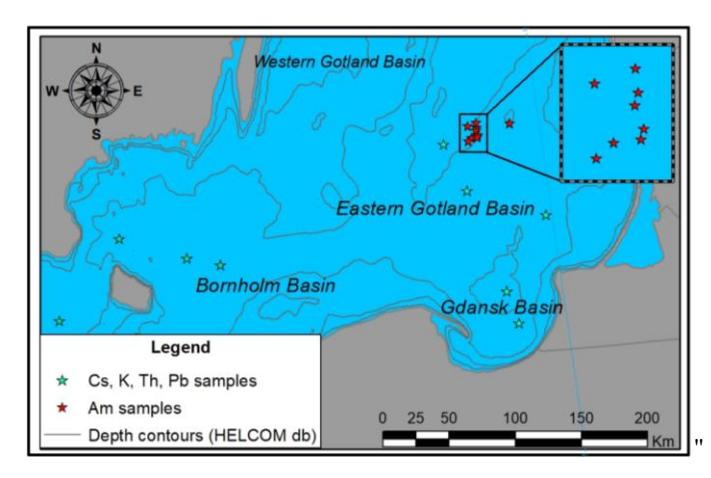
The data obtained during this study showed that in the bottom sediments of the Gotland Deep, 241Am is distributed unevenly in the range of 0.065-0.231 Bq / m3. According to preliminary data, there was a general trend for the 241Am activity to increase with depth. The activity concentrations of 137Cs, 214Pb and 40K in studied samples ranged from 62 to 220 Bq/kg, from 30.1 to 80.2 Bq/kg and from 827 to 1093 Bq/kg, respectively. The obtained results will be used to study sediment transport in the Baltic Sea.