
The phenomenon of concentration quenching has been investigated throughout the last century, however, its origin is not fully understood to this day. An example of such occurrence has been observed in chlorophyll solutions: at higher concentrations the relative fluorescence intensity becomes dependent on the concentration and starts decreasing [1]. It is important to note that in artificial systems the fluorescence is usually significantly quenched at fluorophore concentrations typical to that of unquenched in vivo photosynthetic systems.
In this work, concentration quenching in a two-dimensional system was simulated using approach similar to Ref. [2]. The two-dimensional model was chosen for simplicity, however, its real life equivalent could be an especially thin film or membrane. Molecules, each 1 nm in diameter, were scattered in a 10000 nm2 area using a uniform distribution. Different concentrations were obtained by changing the number of molecules from 100 to 1000. Randomly chosen molecules acted as traps; excitation, after reaching such molecule, could not escape. The amount of traps used were 1%; 2%; 5%; 10%; 20% of the total number of molecules. At the initial time moment, excitation was distributed equally among all non-trap molecules. Time dependence of the total excitation probability was calculated by solving the system of kinetic equations with energy transfer rates between the molecules being proportional to the inverse sixth power of the distance between the molecules, following the Forster level of description. Obtained results were averaged over different molecule distributions and are shown in Fig. 1.
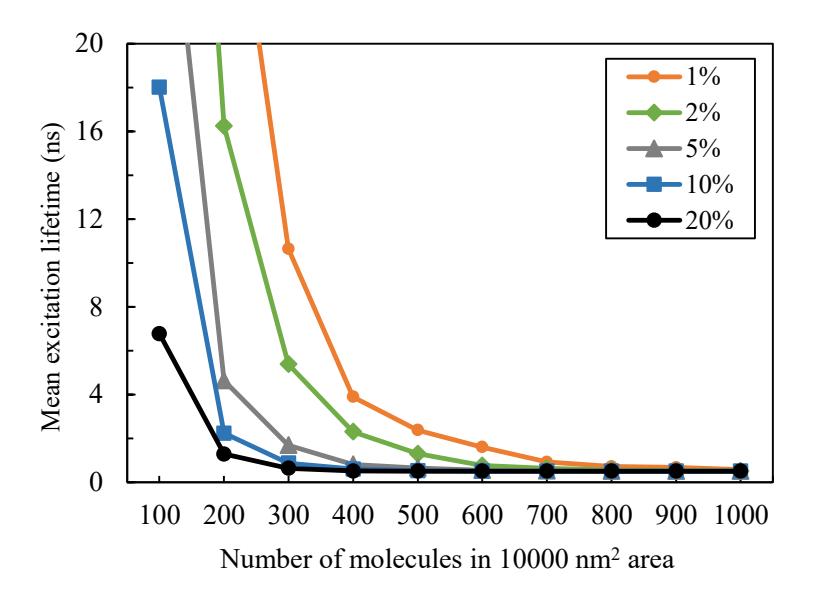
As expected, we can observe that in larger concentrations quenching is more rapid. A comparison between this model and a dynamic quenching model (where traps are formed when two or more molecules are closer to each other than a certain distance) will be presented.