The Iberian Peninsula has been experiencing new temperature records in the last few decades making some parts of this region less and less habitable, especially during summer. To simulate present-day climate conditions accurately and to determine better estimates of extreme temperatures over the southwestern part of Europe, high-resolution regional climate models (RCMs) have been applied. However, it is unknown to which degree state-of-the-art RCMs may tend to overestimate regional amplification of global warming, especially during the warmest months (Christensen et al. 2008[1]; Boberg and Christensen, 2012[2]).
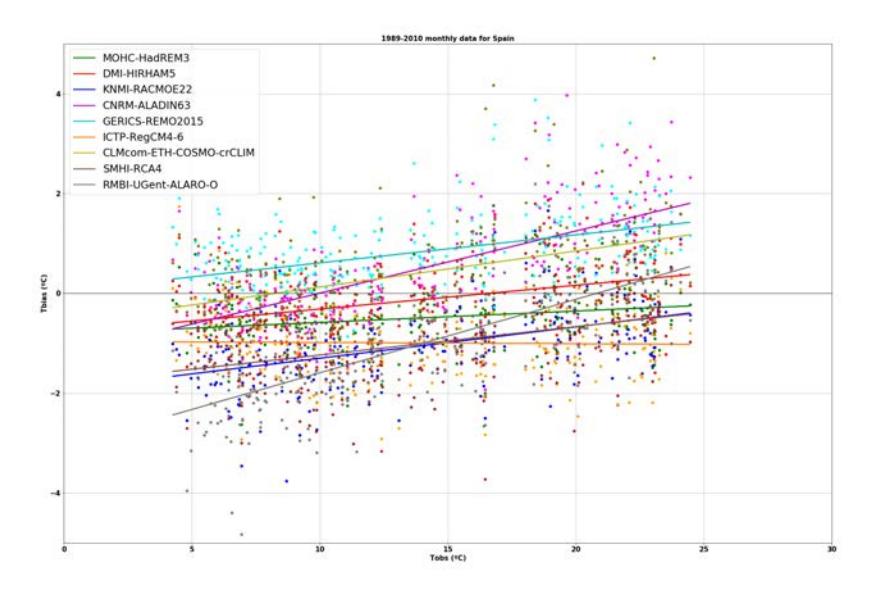
Studies have revealed that RCMs have systematic temperature dependence of biases increasing with temperature. The warmer the month is, the stronger the tendency is. The project aims to analyse potential non-stationary biases between climate simulations (EURO-CORDEX project) and observational datasets over the Iberian Peninsula (Herrera et al., 2015[3]). Such an analysis has not been done with the current high-resolution RCMs or relying on a high-resolution observational dataset before. In addition, the analysis will be extended to also address monthly means of daily maximum and minimum temperatures, which has not been addressed before. A bias correction method could be then be proposed to mend some of the model deficiencies.