
Recently, it has been proposed to use an axisymmetric 3D photonic crystal inside the cavity of a wide aperture microchip laser in order to increase the brightness and the spatial quality of its emission [1]. However, the fabrication of such 3D structures technologically is a very challenging task. Therefore, the idea to combine the properties of 3D photonic crystals [2] and the manufacturing advantages of flat optics by the use of a 2D structure positioned close and parallel to the surface of a mirror has been suggested.
Here we theoretically explain and experimentally prove the far field effects of the axisymmetric diffractive reflector a thin transmissive concentric diffraction grating placed at a distance of several micrometers in front of a flat mirror. This configuration provides the effect of super-collimation which is defined by an enhancement of axial components of Gaussian laser beam reflected from such structure. The interpretation of this effect is based on the axisymmetric diffusion of the radiation during the process of diffraction into higher diffraction orders and then back to the zero-order diffraction.
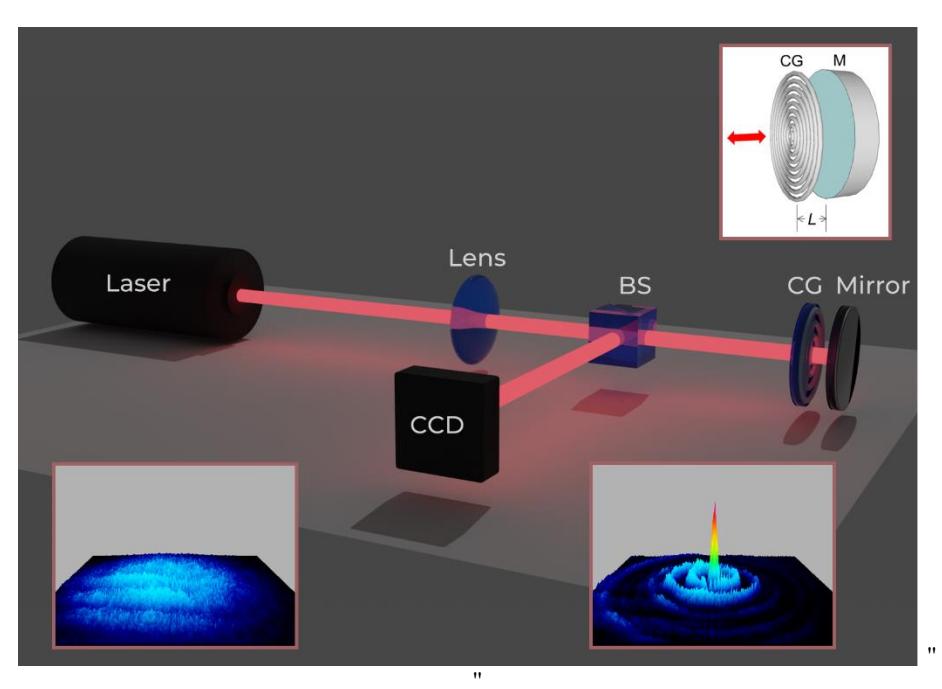
The prototype of the concentric diffraction grating having a quasi-sinusoidal profile and a period of 2 μm was fabricated using electron beam lithography. An experimental investigation of the propagation of a diverging Gaussian beam through the grating-mirror tandem (Fig. 1) showed an increase in axial intensity of the reflected beam by up to 7 times. The obtained result qualitatively and quantitatively agrees with the theoretical prediction of the super-collimation effect.
Such axisymmetric diffractive reflectors used as one (or both) cavity mirrors in microlasers could be especially useful for the improvement of the spatial quality of their radiation.