Over the last 5 years, lead halide perovskite nano- and microstructures have emerged as promising laser medium exhibiting low generation threshold and high quality factor (Q) modes. Among these lasers, external cavity-free single-crystal nanowires and microplates are the most available. They possess high optical gain, well-shaped reflective end facets, and can be grown by cost-effective and large-scale wet chemical approaches at moderate temperature (50-80 °C). One of the possible applications for such lasers could be optical sensing of volatile substances: various organic solvents and hydrogen halides. However, detecting of volatile organic molecules at low concentrations cannot be realized for isolated perovskite nanowire or microplate laser on an ordinary substrate since optical eigenmodes in high refractive index perovskite ($n\approx 2.3$) do not interact effectively with the surrounding low refractive index medium. To address this issue, a perovskite laser needs to be coupled with a whispering gallery mode (WGM) polymer cavity [1] or should be deposited on a nanoporous substrate capable of changing its refractive index owing to the gas sorption process. On the contrary, detecting hydrogen halides vapors with perovskite lasers does not require the change of the refractive index of the surrounding medium because the vapor modifies the surficial chemical composition of the perovskite resonator due to halide exchange reaction [2, 3]. As a result, the change in the complex refractive index for the surface could invoke a small spectral shift of laser modes.
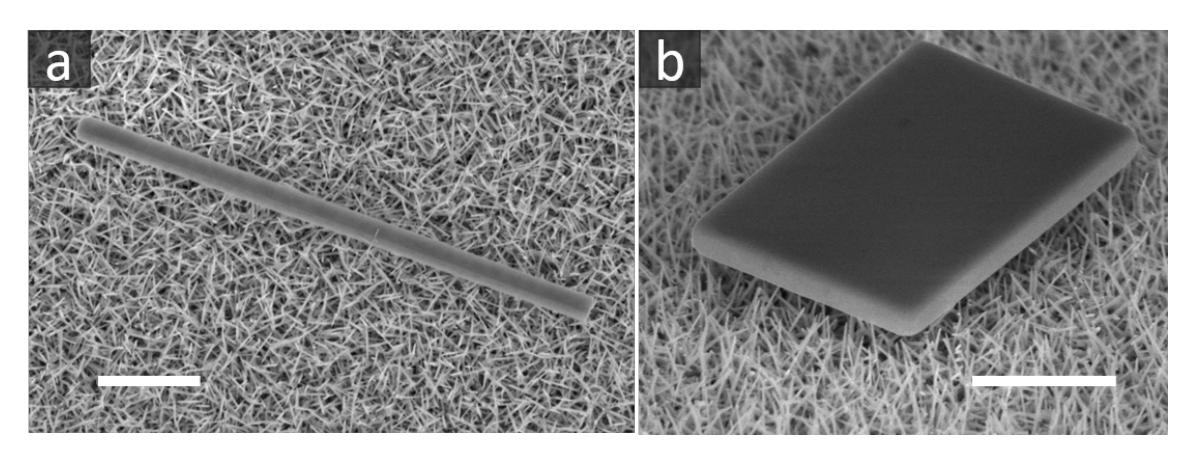
Herein we report on CsPbBr3 nanowires and microplates deposited on a nanostructured indium tin oxide (ITO) substrate (Fig. 1) consisting of ITO whiskers and similar substrate consisting of ITO/Al2O3 whiskers by using a simple wet chemical approach. Perovskite crystals were synthesized on an amorphous SiO2/Al2O3 substrate with island-like surface morphology. Thereafter, they were suspended in non-polar solvent via ultrasonication and deposited on the nanostructured substrates. The obtained perovskite cavities show room-temperature laser generation and high-Q laser modes owing to low refractive index ($n\approx 1.15$) of the substrates. Optical sensing of acetone and hydrogen iodide vapors at different concentrations is discussed.