
Development of new elastomers and their recycling technology is often focused on rheological properties, dynamic moduli in particular [1]. A number of methods can be used for their measurement, primarily highlighting the dependence of storage modulus $G'$ on strain, temperature and other factors. Plate-plate and moving die techniques are often employed. Despite different sample sizes and topography, the techniques exert similar stress onto the elastomer and record the same factors as feedback. This study attempts to compare $G'$, recorded by both techniques on same elastomers. Non-vulcanized Isoprene Rubber (IR) was used to simulate the elastomer with or without squalane (SQ) at 13% wt. as a plasticizer.
Storage modulus $G'$ was measured using the two techniques tuned to operate under similar thermal and mechanical regimes. Plate-plate technique employed a MCR 302 rheometer with Ø 8 mm spindle PP08 (Anton Paar). Temperature sweep was carried out under 0.5% strain at 1 Hz with 5 min preheating for each temperature. Frequency sweeps were taken progressively at 25°C, 100°C and 120°C with 5 min preheating under 0.5% strain, total duration of ~2 h. Load was constant at 1 N. The elastomer samples were pre-cut into Ø 8.5 ± 0.5 mm discs 0.5 ± 0.1 mm thick. Moving die technique employed D-MDR 3000 rheometer (Montech, Germany) with biconical dies per ASTM D6204, guarded by disposable polymer sheets. Strain sweep (0.02 – 90% range, 3 cycles for each angle under 1 Hz) and frequency sweep (0.01 – 50 Hz range, 3 cycles for each frequency under 0.5% strain) were carried concurrently on the same specimen at 25°C, 100°C and 120°C with 5 min preheating and total duration of 2 h per sample. Temperature sweep (25 – 120°C with 5°C step every 1.4 min under 1 Hz and 0.5% strain) was performed on different specimens. In both techniques the attempts were made to avoid bubbles, wrinkles or other imperfections, however perfect adherence to plate surface could not be assured. Built-in software calculated $G'$ whose values were processed from multiple runs using Origin software to derive error bars. The most representative curves are shown in Fig. 1.
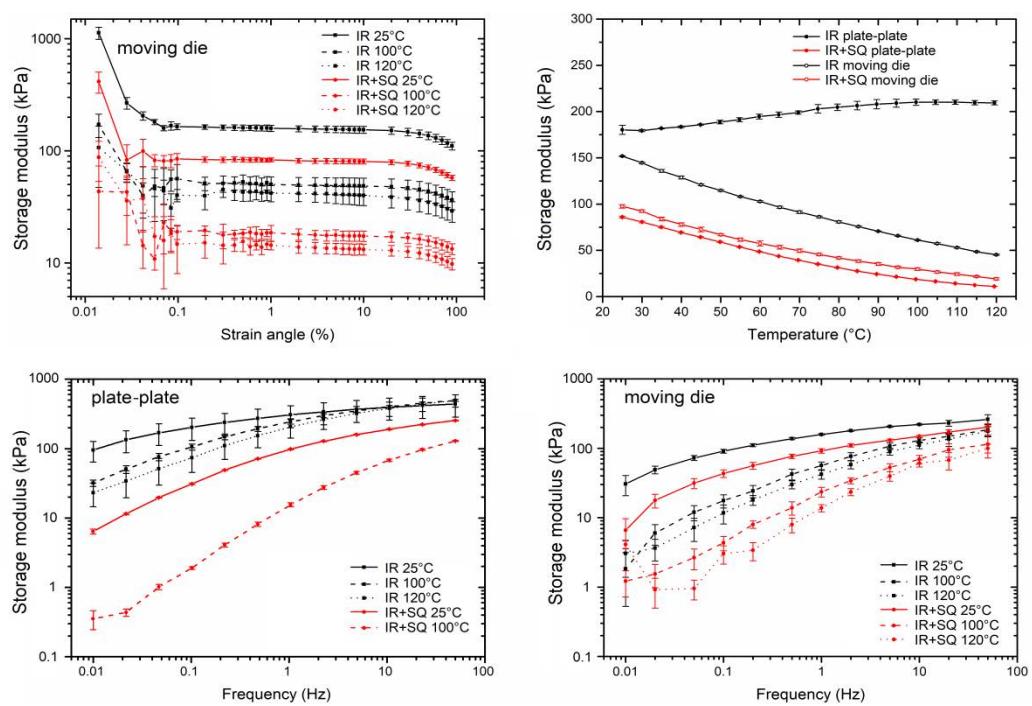
Temperature effects on non-plastified IR appear inexplicably opposite. Despite these and other differences in recorded values, tendencies of $G'$ dependence on frequency and plastification appear similar and match expectations. It can be noted that frequency sweep at 120°C by the plate-plate technique matches results from other researchers quite well [1]. Therefore, both techniques can be instrumental in evaluation of rheological properties of elastomers and composites.