Concentration quenching, or aggregation-induced quenching, occurs when the fluorescence quantum yield of fluorophores is significantly reduced upon increase of fluorophore concentration. This phenomenon is encountered in many systems [1]. From biological point of view, a particularly interesting case is quenching in chlorophyll solutions, which has been examined from the middle of previous century to this day [2,3].
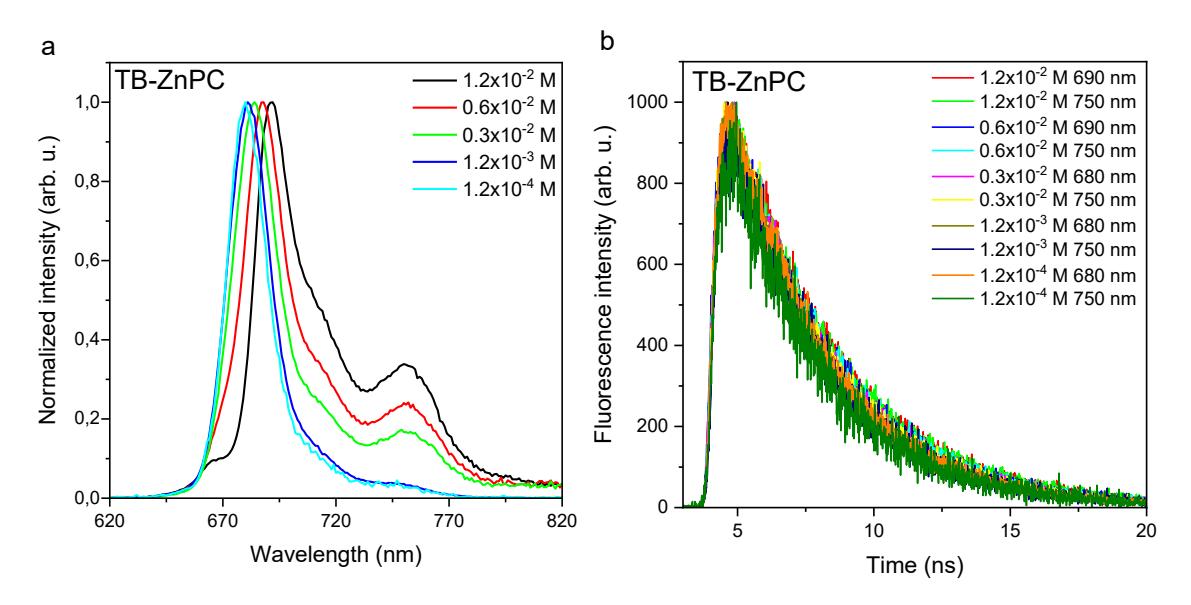
In this work, we experimentally examine concentration quenching of Zinc 2,9,16,23-tetra-tert-butyl-29H,31H-phthalocyanine (TB-ZnPC). While phthalocyanine molecules are interesting in their own right [4], their similarity to chlorophyll makes them excellent model systems. It is often argued that formation of H-aggregates is responsible for fluorescence quenching. In Fig. 1a we present the fluorescence spectra of TB-ZnPC in ethanol for a few concentrations. The relative increase of the longer wavelength transition upon increasing concentration demonstrates formation of aggregates for TB-ZnPC molecules. The monomer transition demonstrates redshift upon increasing concentration, also consistent with aggregate formation. Meanwhile, in Fig. 1b the fluorescence decay kinetics are shown and only a minimal dependence upon concentration can be observed. This suggests that no simple relation exists between the mean excitation lifetime and the quantum yield which will be discussed in the presentation.