It has been long held that Galactic globular clusters (GGCs) are homogeneous objects consisting of stars that have the same age and chemical composition. However, research done during the past decade has shown that stars in the GGCs do not share the same chemical composition and may have formed during different star formation episodes (see, e.g., [1]). This suggests that GGCs may consist of two (or more) generations of stars, with the second generation born from the material enriched by the ejecta of first-generation stars, with the most plausible candidates being fast-rotating massive stars [2] and asymptotic giant branch (AGB) stars [3], the so-called polluters. Unfortunately, our current knowledge about the GGCs does not allow us to discriminate between the possible pollution scenarios.
In order to determine which polluters were most likely to enrich the intracluster medium during the early stages of GGC formation, one may look at the abundances of s-process elements. Since the light (peak around Sr, Y, Zr) and heavy (peak around Ba, La) s-process elements are produced in different types of objects, correlations between abundances of light/heavy s-process elements and those of light elements (N, Na) may allow us to put tighter constraints on the possible polluters. One earlier study has suggested a tentative existence of a correlation between the abundances of Na and Ba in the globular cluster 47 Tuc (note that Ba is a heavy s-process element and is synthesized during the main s-process, which mostly takes place in low-mass AGB stars) [4]. To check if such a correlation may also exist in the case of Zr, which is a light s-process element and is synthesized during the weak s-process, we determined Zr abundance in 283 RGB stars in 47 Tuc. Importantly, the studies of Zr abundance in the GGCs have been very scarce until now and the results were inconclusive, i.e., not only for this but also for other GGCs.
Abundance analysis was based on the archival spectra of RGB stars in 47 Tuc that were obtained with GIRAFFE spectrograph mounted on the VLT UT2 telescope (ESO, Chile). Three spectral lines of neutral Zr were used, with their central wavelengths located at 612.7475 nm, 613.4585 nm and 614.3252 nm. Line equivalent widths were measured using IRAF package, by fitting Gaussian profiles to the observed spectral lines. Stellar model atmospheres were computed using the ATLAS9 code and were further employed to derive 1D LTE Zr abundances with the WIDTH9 package.
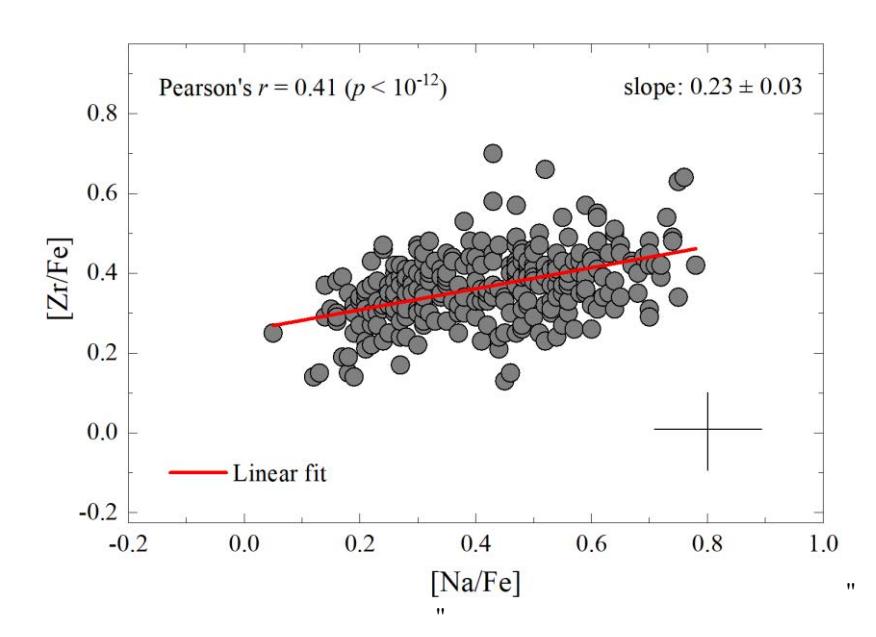
The mean Zr to Fe abundance ratio that we obtained in a sample of 283 RGB stars in 47 Tuc is $[\text{Zr/Fe}] = +0.37 \pm 0.09$ (the error is standard deviation due to star-to-star abundance variation). This is so far the largest sample of RGB stars analyzed in this cluster for Zr abundance. Analysis of Zr and Na abundances shows a weak, but statistically significant correlation (Fig. 1). Taken together with the $[\text{Ba/Fe}]$ ratios determined by [4], our results suggest that in this GGC both elements were synthesized in massive AGB stars.