Additive manufacturing (AM) is a manufacturing technology used for 3D object production which opens a pathway to fabricate complex parts due to the high geometrical flexibility of the technology [1]. Direct Metal Laser Sintering (DMLS) is one of the most widely applied metal AM technologies, where, in a layer-by-layer fashion, bulk parts are created by selective sintering and consolidation of thin powder layers using a laser beam [2]. DMLS can be used for part fabrication using different metals and their alloys. Although iron and its alloys have been used in conventional manufacturing for a long time and the most advantages and disadvantages of these materials are well known, using them in additive manufacturing to achieve high quality still can be problematic. In DMLS, the main challenge is to understand the influence of energy density on porosity, microstructure and mechanical properties of a manufactured part.
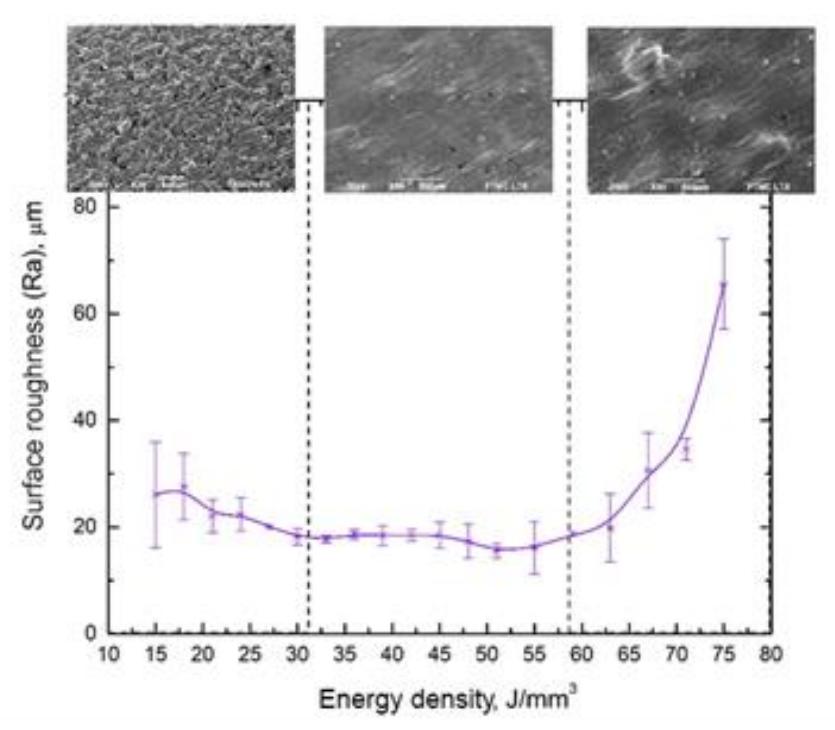
In this study, test specimens were produced from 17-4PH stainless steel using different sets of build parameters on the EOSINT M280 machine in order to determine the influence of different process parameters and specimen positioning on specimen surface quality. A stylus profiler was used in the study to determine the relation between specimen positioning on the build platform during the printing process and the surface roughness of printed objects. To better understand what causes different surface roughness in specimens produced with various volumetric energy density values, cross-sectional microstructure of the manufactured specimens was investigated using scanning electron microscopy (SEM) and optical microscopy and defects visible in cross-sections were evaluated with help of image processing software.
Results have shown that the best surface quality can be achieved when the energy density values during the manufacturing process are from 48 to 65 J/mm3. However, only applying certain energy density is not sufficient and surface quality differs depending on the surface's positioning on the building platform.