
Recently, photoelectrochemical (PEC) sensing techniques have attracted substantial research interest in the area of detection of biomolecules. Compared to conventional electrochemical methods, the PEC sensor has high sensitivity and a low background signal, which can be ascribed to its separate excitation source and detection signals [1]. Efficiency of PEC systems strongly depends on photoanodes, which convert the energy of visible light into chemical energy. Among the various photoelectrodes studied for PEC applications, monoclinic bismuth vanadate (BiVO4) is considered to be a promising material owing to its moderate band gap (2.4 eV) and appropriate band-edge positions, which allow it to absorb as much as 11% of the solar spectrum. Nevertheless, the photocatalytic activity of bare BiVO4 is still not ideal for practical applications because of its excessive charge recombination, poor charge transport, and slow oxidation kinetics [2].
In our work citric acid, urea and polyethylene glycol (PEG) were used as stabilizing agents for formation of BiVO4 thin films in sol-gel approach. Organic additives serve as complexing agents of Bi3+ ion, therefore different morphology and photoelectrochemical properties of BiVO4 coatings are obtained. Ratio of citric acid and PEG to BiVO4 was chosen to be 2:1, however ratio of urea to BiVO4 was 0.5:1, because at higher amounts of urea formation of precipitates occurred. After dip-coating of BiVO4 on conducting glass (FTO) substrate all samples were annealed at 450°C for 2h. Crystallinity and morphology of coatings were evaluated using X-ray diffraction (XRD) and scanning electron microscopy (SEM) analysis. Photoelectrochemical response of obtained coatings were analyzed using cyclic voltammetry in three electrode cell in 0.5M Na2SO4 solution in the dark and under illumination (Fig. 1). Photoelectrochemical oxidation of glucose was studied in three electrode cell in sodium borate buffer (pH=9) with 5-35mM of glucose.
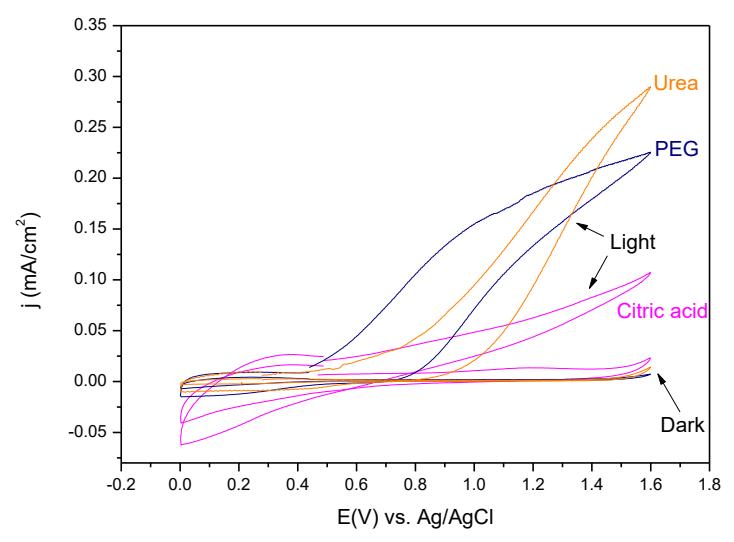
Obtained results revealed, that different stabilizing agents strongly influence morphology and PEC activity of the coatings. The highest photocurrent was obtained for coating synthesized with urea (Fig. 1). Photoelectrochemical oxidation of glucose showed the linear enhancement of photocurrent with increased concentration of glucose in the range of 5~35 mM. Obtained sensitivity of BiVO4 for glucose detection will be evaluated and presented.